Short Answer
Have you ever looked up at the night sky and noticed something peculiar about the Moon? What if we told you that the Moon appears “reversed” depending on where you are on Earth? This phenomenon isn’t just a trick of the eye—it’s a fascinating shift in perspective that challenges our understanding of celestial mechanics. In this guide, you’ll uncover the science behind why the Moon looks different from the Northern and Southern Hemispheres, explore the cultural and psychological implications of this reversal, and discover how this simple observation can lead to profound insights about our place in the universe. By the end, you’ll never look at the Moon the same way again.
The Science Behind the Moon’s Reversed Appearance
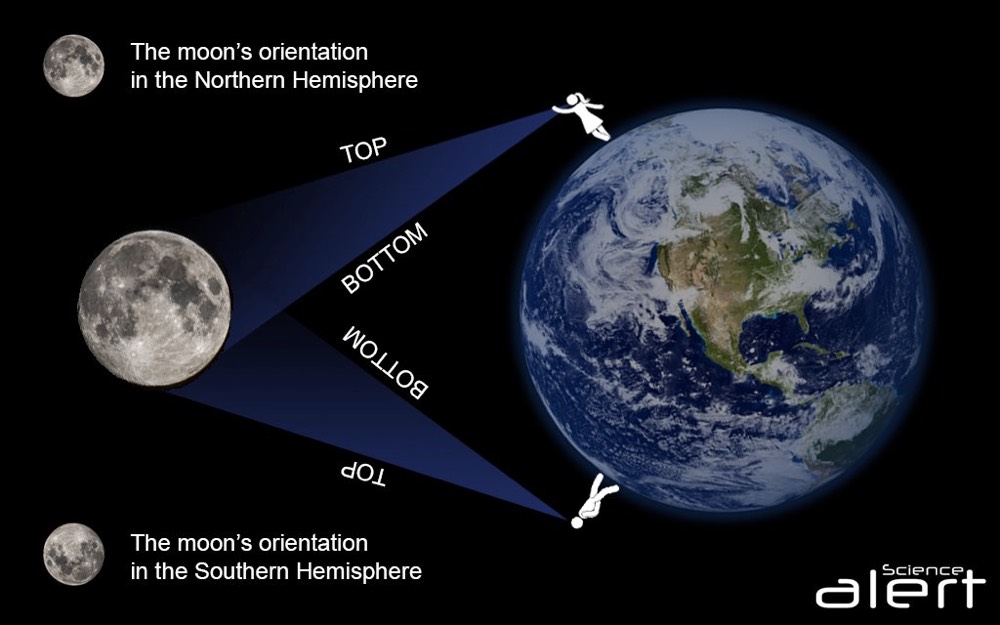
The Moon’s orientation changes dramatically depending on your location on Earth. In the Northern Hemisphere, the Moon appears “right-side up” with the familiar “man in the Moon” or “rabbit in the Moon” patterns oriented vertically. However, if you travel to the Southern Hemisphere, the Moon appears flipped upside down, as if viewed through a mirror. This isn’t an illusion—it’s a direct result of our planet’s spherical shape and the way we observe the Moon from different latitudes.
To understand this, imagine standing at the North Pole. The Moon would appear to circle the sky in a counterclockwise direction, with its “top” (the lunar north pole) pointing toward the celestial north. Now, transport yourself to the South Pole. The Moon’s path now appears clockwise, and its orientation flips vertically. This reversal is purely a matter of perspective. The Moon itself doesn’t change; it’s our vantage point that shifts. The lunar phases, such as the crescent or gibbous phases, also appear mirrored between hemispheres, adding another layer of complexity to this celestial dance.

Cultural Interpretations of the Moon’s Reversed Image
The Moon’s reversed appearance has captivated human imagination for centuries, inspiring myths, art, and even religious symbolism. In many Indigenous Australian cultures, the Moon is often depicted as a “man” or a “woman” lying on their back, which aligns with the Southern Hemisphere’s perspective. This contrasts sharply with Northern Hemisphere traditions, where the Moon is frequently portrayed as a face or figure standing upright. These cultural interpretations highlight how a single celestial object can take on vastly different meanings based on geographic location.
In Western astrology, the Moon’s phases are often associated with emotions, intuition, and femininity. The reversed Moon in the Southern Hemisphere might symbolize a subversion of these traditional associations, suggesting a need to look at things from a different angle. Some cultures even believe that the Moon’s flipped appearance is a sign of balance—reminding us that duality and perspective are essential to understanding the world. Whether viewed through a scientific or spiritual lens, the Moon’s reversal serves as a metaphor for the fluidity of perception.
How the Moon’s Reversal Challenges Our Perceptions
Our brains are wired to recognize patterns, and the Moon’s familiar face is one of the most recognizable celestial patterns in human history. When we see the Moon reversed, it creates a cognitive dissonance—a momentary confusion that forces us to question what we think we know. This disruption of expectation can be unsettling, but it also offers an opportunity for growth. By confronting the unfamiliar, we expand our understanding of the universe and our place within it.
The Moon’s reversal also challenges the idea of a “fixed” reality. What we perceive as “normal” is often just a matter of where we stand. This concept extends beyond astronomy; it applies to how we view politics, culture, and even personal beliefs. The Moon’s flipped image reminds us that truth is often relative, and what seems obvious from one perspective may appear entirely different from another. Embracing this fluidity can lead to greater empathy, creativity, and intellectual humility.
The Psychological Impact of Seeing the Moon Reversed
Psychologists have long studied how unexpected visual stimuli can alter our perception and emotional responses. The Moon’s reversed appearance triggers a primal reaction—our brains struggle to reconcile the familiar with the unfamiliar, leading to a brief moment of disorientation. This phenomenon is similar to the “uncanny valley” effect, where something that should be familiar feels subtly wrong, evoking a sense of unease or curiosity.
Interestingly, this psychological response can also be empowering. When we encounter something that defies our expectations, it prompts us to ask questions, seek answers, and engage more deeply with the world around us. The Moon’s reversal, therefore, isn’t just a quirk of astronomy—it’s a tool for self-discovery. It encourages us to question our assumptions, remain open to new perspectives, and find wonder in the unexpected. In a world where information is often presented in rigid, binary terms, the Moon’s flipped image serves as a gentle reminder that reality is far more nuanced.
Practical Ways to Observe the Moon’s Reversal
If you’ve never seen the Moon reversed, the best time to observe it is during a full moon, when the entire face is visible. Traveling between hemispheres is the most straightforward way to witness this phenomenon firsthand. For example, if you’re in the Northern Hemisphere, a trip to Australia, New Zealand, or South Africa will reveal the Moon’s flipped orientation. Alternatively, you can use astronomy apps or websites that simulate the Moon’s appearance from different locations on Earth.
For those unable to travel, virtual planetarium tools like Stellarium or The Sky Live can provide a simulated view of the Moon from any point on the globe. These tools are invaluable for understanding how the Moon’s orientation changes with latitude. Additionally, photographers can capture the Moon’s reversed appearance by taking images from different hemispheres and comparing them side by side. This hands-on approach not only enhances your appreciation of the phenomenon but also deepens your connection to the cosmos.

Conclusion
The Moon’s reversed appearance is more than just a quirk of geography—it’s a gateway to rethinking how we perceive the world. From the science of celestial mechanics to the cultural myths that surround it, the flipped Moon challenges us to question our assumptions and embrace the beauty of perspective. Whether you’re an astronomer, a traveler, or simply someone who gazes at the night sky in wonder, the Moon’s reversal offers a profound lesson: that what we see is not always what we get, and that clarity often comes from looking at things from a new angle.
Next time you look up at the Moon, take a moment to consider where you are on Earth. Are you seeing it right-side up, or is it flipped upside down? Either way, the Moon is a constant reminder that the universe is full of surprises—and that the key to understanding it lies in our willingness to see things differently.
FAQ
Why does the Moon look reversed in the Southern Hemisphere?
Because of the Earth's curvature and the observer's viewpoint, the Moon's orientation appears flipped when viewed from the Southern Hemisphere.
Is the Moon itself flipped or changed physically?
No, the Moon's orientation does not physically change; the reversal is due to how we view it from Earth.
How can I observe the Moon's reversed appearance if I can't travel?
Using virtual planetarium software or astronomy apps simulating views from different hemispheres allows observation of the Moon's reversed orientation.
What does the reversed Moon symbolize culturally?
It often symbolizes perspective shifts, duality, and balance, with different meanings across cultures depending on hemisphere.
Leave a Reply