Short Answer
Tarot card combinations are a powerful tool for unlocking deeper, hidden messages within your readings. Whether you’re a beginner or an experienced reader, understanding how cards interact can reveal nuanced insights that single-card draws often miss. In this guide, you’ll explore the fundamentals of tarot combinations, learn how to interpret them effectively, and discover why they captivate so many seekers of wisdom. By the end, you’ll have the knowledge to enhance your readings and uncover layers of meaning that go beyond individual card meanings.
Why Tarot Card Combinations Matter
Tarot card combinations are more than just a way to shuffle meanings—they’re a gateway to deeper understanding. When cards appear together, their energies interact, creating a narrative that’s richer than the sum of its parts. For example, the Fool followed by the Tower might suggest a sudden, unexpected change after a period of innocence or spontaneity. This interplay reveals the dynamics of a situation, offering clarity where a single card might leave you puzzled.
Many readers notice that combinations often feel more “alive” than individual cards. This is because the juxtaposition of symbols, colors, and archetypes creates a story that resonates on a subconscious level. The fascination with combinations lies in their ability to mirror real-life complexities, where outcomes are rarely determined by one factor alone. By studying these interactions, you tap into a more holistic approach to divination, one that aligns with the interconnected nature of life itself.
How to Read Tarot Card Combinations
Reading tarot combinations requires a blend of intuition and structure. Start by examining the individual meanings of each card, then observe how their themes overlap or contrast. For instance, the High Priestess and Three of Cups together might indicate intuitive insights shared among a group, blending mystery with celebration. Pay attention to:
- Dominant Themes: Does one card’s message overshadow the other? For example, the Death card paired with the Ten of Pentacles could suggest transformation within family or legacy.
- Card Positions: In a spread, the order of cards matters. A past-present-future layout might show how a situation evolved, where the combination of cards in the middle and end positions reveals turning points.
- Elemental Dignities: The elements (fire, water, air, earth) of the cards influence their compatibility. Fire (e.g., Wands) and water (e.g., Cups) often clash, while earth (e.g., Pentacles) and air (e.g., Swords) may harmonize.
Practice with simple two-card spreads to build confidence. Over time, you’ll develop a knack for spotting patterns and trusting your gut when a combination feels particularly potent.

Common Tarot Card Combinations and Their Meanings
Some combinations appear frequently in readings and carry universal themes. Here are a few worth memorizing:
- The Lovers + The Chariot: A powerful duo suggesting a choice between heart and ambition. It may indicate a relationship that requires willpower to overcome challenges or a decision where passion drives action.
- Five of Swords + The Hermit: A warning against conflict or deception, followed by a need for solitude to reflect. This combination often surfaces when someone is grappling with regret or isolation after a battle.
- Queen of Cups + The Moon: Emotional depth meets illusion. This pairing might reveal hidden feelings, intuition guiding you through uncertainty, or a need to trust your subconscious insights.
- Ten of Wands + Judgment: Burdened by responsibility, but a call to awaken to a higher purpose. This combination suggests that what feels like a heavy load may actually be a step toward transformation.
These examples highlight how combinations can shift meanings entirely. The key is to avoid rigid interpretations and instead let the cards’ dialogue guide you.
The Psychology Behind Tarot Combinations
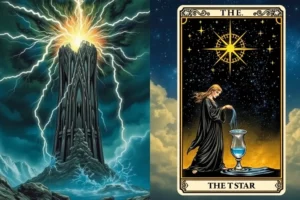
Tarot combinations resonate deeply because they tap into cognitive and emotional patterns. Psychologically, the brain seeks patterns to make sense of chaos—a phenomenon known as pareidolia. When you see the Star followed by the Temperance, your mind might weave a story of hope leading to balance, even if the cards themselves don’t explicitly state it. This mental storytelling is what makes combinations feel so personal and revelatory.
Additionally, combinations can reflect the halo effect, where one strong card colors the interpretation of others. For example, the Devil card might make the Three of Swords feel more ominous, even if the latter typically represents heartbreak rather than despair. Understanding this bias helps you stay objective and consider all angles of a reading.
Advanced Techniques for Interpreting Combinations
Once you’re comfortable with basic combinations, explore advanced methods to deepen your practice:
- Card Reversals: Reversed cards add complexity. The Eight of Pentacles reversed alongside the Six of Cups could indicate unfulfilled nostalgia or a need to revisit old skills with renewed focus.
- Astrological Correspondences: Align cards with zodiac signs or planetary influences. For instance, the Knight of Swords (a Mars-influenced card) with the Sun might suggest a bold, fiery energy in a situation.
- Numerology: Add the numbers of the cards together. The Two of Cups (2) and Three of Wands (3) total 5, hinting at change or conflict in a relationship.
- Storytelling Spreads: Use a narrative spread (e.g., beginning, middle, end) to map out how combinations unfold over time. This is especially useful for career or relationship readings.
Experiment with these techniques to find what resonates with your intuitive style. The more you practice, the more fluid your interpretations will become.

Common Mistakes to Avoid
Even experienced readers can fall into traps when interpreting combinations. Be mindful of these pitfalls:
- Overcomplicating: Not every combination needs a grand narrative. Sometimes, the simplest interpretation is the most accurate. If the Page of Wands and Ace of Cups appear, it might just mean a new creative spark in your emotional life—no need to force a dramatic story.
- Ignoring Context: Always consider the question or situation behind the reading. The Five of Pentacles and Ten of Cups could mean financial struggle in a family context but material loss in a career reading.
- Relying Solely on Guidebooks: While reference guides are helpful, they shouldn’t replace your intuition. If a combination feels off to you, trust that feeling—it might be highlighting a unique aspect of the reading.
- Fear of Silence: Not every combination will “click” immediately. If a pairing feels unclear, sit with it. Sometimes, the message reveals itself days or even weeks later.
Conclusion
Tarot card combinations are a gateway to deeper, more nuanced insights in your readings. By learning to interpret the interactions between cards, you unlock layers of meaning that single-card draws can’t provide. Start with simple pairings, observe how themes overlap or contrast, and gradually incorporate advanced techniques like reversals, numerology, and storytelling. Remember that the magic of combinations lies in their ability to mirror life’s complexities—where no single factor dictates the outcome, but every detail contributes to the whole.
As you continue your practice, trust your intuition and stay open to the unexpected messages that arise. The more you engage with tarot combinations, the more you’ll appreciate their power to reveal hidden truths and guide you toward clarity. Whether you’re seeking answers about love, career, or personal growth, these combinations will serve as a trusted companion on your journey of self-discovery.
FAQ
What are tarot card combinations?
Tarot card combinations involve interpreting two or more cards together to reveal deeper meanings and complex narratives beyond individual card interpretations.
Why should I learn tarot card combinations?
They help you gain richer insights and more nuanced understanding in readings by showing how card energies interact and influence each other.
How do elemental dignities affect tarot combinations?
Elements like fire, water, air, and earth influence card compatibility; harmonious elements support each other while clashing elements may indicate tension.
What advanced techniques can enhance reading combinations?
Using card reversals, numerology, astrological correspondences, and storytelling spreads can deepen your interpretations.
What common mistakes should I avoid with tarot combinations?
Avoid overcomplicating meanings, ignoring the reading’s context, relying solely on guidebooks, and forcing interpretations.
Leave a Reply