Short Answer
In this comprehensive guide, you will explore the rich history, symbolism, and interpretations of the Tarot de Marseille—a deck older than the popular Rider-Waite-Smith Tarot. Whether you are a beginner seeking foundational knowledge or an experienced reader looking to deepen your understanding, this article covers the essential aspects of Marseille Tarot meanings. You’ll discover how its imagery differs from modern decks, learn about the significance of each card, and gain insights into traditional spreads and reading techniques. By the end, you’ll have a thorough grasp of why the Marseille Tarot remains a timeless tool for divination and self-reflection.
What Is the Tarot de Marseille?
The Tarot de Marseille is one of the oldest known Tarot decks, originating in the 15th century in Italy before evolving in France. Unlike the Rider-Waite-Smith deck, which features detailed, illustrative scenes, the Marseille Tarot is characterized by its minimalist, symbolic artwork. Each card typically includes only essential imagery, such as a central figure, symbolic objects, and bold colors like red, blue, and gold. This simplicity allows readers to focus on the deeper, archetypal meanings rather than being distracted by elaborate scenes. The deck consists of 78 cards divided into the Major Arcana (22 cards representing significant life themes) and the Minor Arcana (56 cards divided into four suits: Wands, Cups, Swords, and Coins). Understanding the Marseille Tarot means appreciating its historical roots and how its imagery has influenced countless modern decks.

The Major Arcana: Archetypal Journeys and Life Lessons
The Major Arcana cards in the Marseille Tarot represent pivotal life experiences, spiritual lessons, and universal human themes. Unlike the Minor Arcana, these cards often depict figures and symbols that resonate across cultures and time periods. For example, The Fool (Le Mat) symbolizes new beginnings and spontaneity, while The Lovers (L’Amoureux) represents choices, relationships, and harmony. Each card in the Major Arcana follows a narrative arc, often interpreted as a journey from innocence (The Fool) to enlightenment (The World). Traditional Marseille interpretations emphasize the esoteric and philosophical aspects of these cards, making them powerful tools for introspection and guidance. To read the Major Arcana effectively, focus on the interplay between the cards in a spread, as their sequence often reveals deeper insights into the querent’s path or situation.
Minor Arcana: Everyday Experiences and Practical Insights
The Minor Arcana in the Marseille Tarot mirrors the structure of a standard playing card deck, divided into four suits: Wands (Batons), Cups, Swords, and Coins (Pentacles). Each suit corresponds to an element—fire, water, air, and earth, respectively—and reflects different aspects of daily life. Wands relate to creativity, ambition, and action; Cups to emotions, relationships, and intuition; Swords to intellect, conflict, and communication; and Coins to material wealth, stability, and practical matters. Unlike the Rider-Waite deck, Marseille cards in the Minor Arcana often feature simpler, more abstract imagery, such as a single figure holding an object or a symbolic scene. This minimalism encourages readers to rely on traditional meanings and intuitive connections rather than relying on detailed illustrations. For instance, the Ace of Cups in Marseille may show a single cup overflowing with water, symbolizing emotional abundance, while the Ten of Swords depicts a figure pierced by ten swords, indicating a painful but transformative ending.
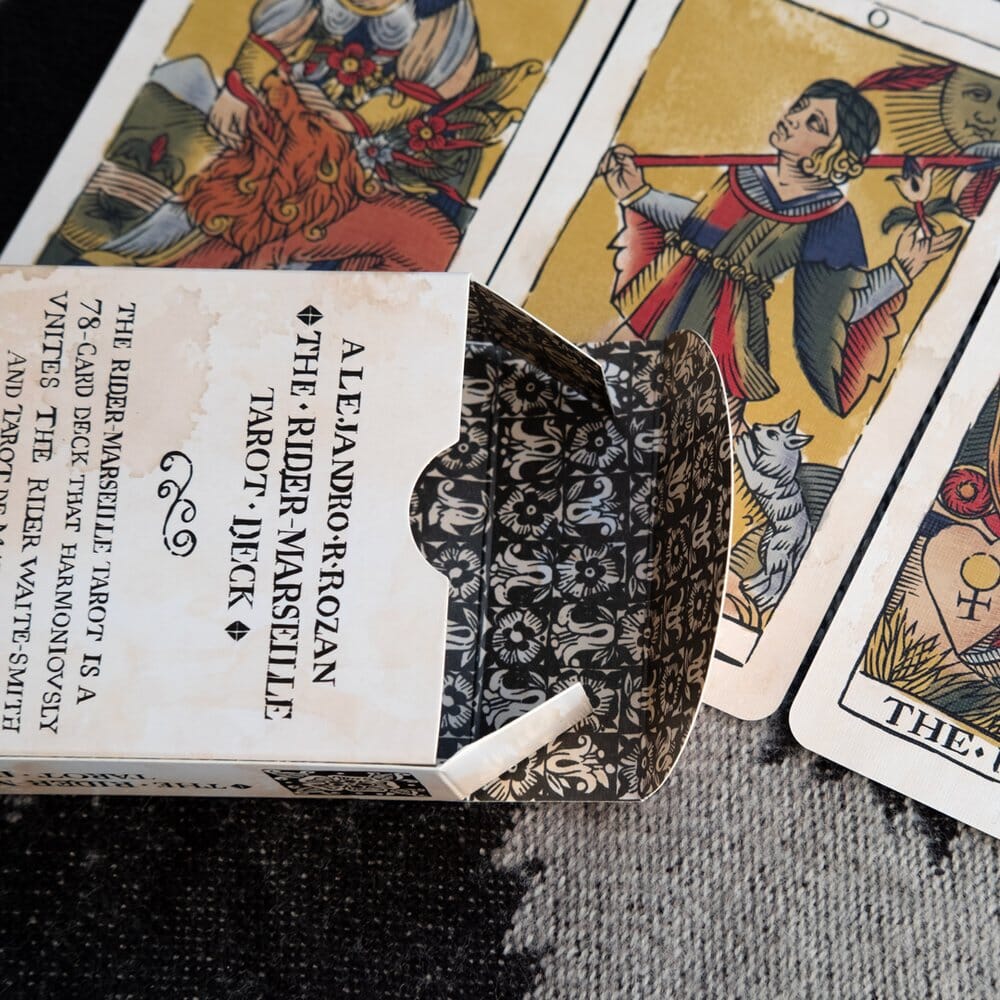
Key Differences Between Marseille and Rider-Waite Tarot
While the Rider-Waite-Smith Tarot is celebrated for its vivid, narrative-driven imagery, the Marseille Tarot offers a more abstract and symbolic approach. One of the most notable differences is the depiction of the Major Arcana cards. For example, The High Priestess in Rider-Waite shows a woman seated between two pillars with a crescent moon at her feet, while in Marseille, she is often a simpler figure holding a book or scroll, emphasizing secrecy and hidden knowledge. Similarly, the court cards in Marseille are less individualized, often representing general personality traits rather than specific characters. Another difference lies in the numbering and titles of some cards; for instance, Justice and Strength are sometimes swapped in position between the two decks. Understanding these differences is crucial for readers who wish to work with both decks or transition from one to the other. The Marseille Tarot’s simplicity can be both a strength and a challenge—it requires a deeper engagement with symbolism but rewards readers with a more direct connection to the cards’ esoteric roots.
Traditional Marseille Tarot Spreads and Reading Techniques
Reading the Marseille Tarot often involves spreads that highlight its symbolic and archetypal nature. One classic spread is the “Three-Card Spread,” which represents past, present, and future, or mind, body, and spirit. Another popular choice is the “Celtic Cross,” adapted for Marseille’s style, where the central card (the significator) is surrounded by cards representing challenges, influences, and potential outcomes. Because the Marseille deck lacks the detailed scenes of Rider-Waite, readers often rely more on elemental dignities, numerology, and astrological correspondences to interpret the cards. For example, a cluster of Swords in a spread might indicate mental stress or conflict, while multiple Cups suggest emotional fulfillment. Additionally, Marseille readers frequently use “elemental spreads,” where cards are placed according to their suit and element to create a cohesive narrative. Practicing with these spreads will help you develop a more intuitive and nuanced understanding of the deck’s traditional meanings.
Symbolism and Esoteric Connections in the Marseille Tarot
The Marseille Tarot is deeply rooted in esoteric traditions, including alchemy, Kabbalah, and astrology. Each card is rich with symbolic elements that connect to these systems. For instance, The Magician (Le Bateleur) often features a table with symbols of the four suits, representing the alchemical elements and the magician’s ability to manifest reality. The Wheel of Fortune (La Roue de Fortune) may include Hebrew letters or astrological symbols, reflecting the cyclical nature of fate. The Chariot (Le Chariot) is frequently associated with the zodiac sign Cancer, symbolizing control and determination. To deepen your understanding, study the historical grimoires and occult texts that reference the Marseille Tarot, such as the works of Antoine Court de Gébelin or the teachings of the Hermetic Order of the Golden Dawn. By exploring these connections, you’ll uncover layers of meaning that enrich your readings and connect the deck to broader spiritual traditions.

How to Learn and Practice with the Marseille Tarot
Learning the Marseille Tarot requires patience, study, and practice. Start by familiarizing yourself with the deck’s structure and traditional meanings, using guidebooks or historical texts as references. Unlike modern decks, the Marseille Tarot does not come with a built-in guide to its imagery, so you’ll need to rely on external resources. Consider joining study groups or online forums dedicated to Marseille Tarot enthusiasts, where you can share insights and learn from others. Practice daily draws or simple spreads to build your intuition and recognize patterns. Keep a journal to track your interpretations and note how the cards resonate with your experiences. Over time, you’ll develop a personal relationship with the deck, allowing you to blend traditional meanings with your own intuitive insights. Experiment with different reading techniques, such as elemental dignities or timing methods, to see what works best for you. The key is to approach the deck with an open mind and a willingness to explore its depth.
Conclusion
The Tarot de Marseille is more than just a deck of cards—it is a window into centuries of esoteric wisdom, symbolic art, and spiritual inquiry. By studying its imagery, understanding its historical context, and practicing with its traditional spreads, you’ll gain a profound appreciation for its unique place in the world of Tarot. Whether you use it for divination, meditation, or personal growth, the Marseille Tarot offers a direct and unfiltered connection to the archetypal forces that shape our lives. As you continue your journey with this timeless deck, remember that its power lies not in its complexity, but in its ability to reveal the universal truths that resonate within us all.
FAQ
What is the Tarot de Marseille?
The Tarot de Marseille is a historic tarot deck from the 15th century known for its symbolic and minimalist card designs.
How does the Tarot de Marseille differ from the Rider-Waite deck?
It uses simpler imagery emphasizing symbolism and archetypes, whereas Rider-Waite features detailed narrative scenes on cards.
What are the suits in the Tarot de Marseille?
The suits are Wands (Batons), Cups, Swords, and Coins (Pentacles), each linked to an element and aspects of life.
Which tarot spreads work well with the Tarot de Marseille?
Traditional spreads like the Three-Card Spread and the Celtic Cross, supplemented by elemental and numerological methods.
How can I start learning the Tarot de Marseille?
Begin with studying card meanings, practicing spreads, joining study groups, and keeping a reading journal to build intuition.
Leave a Reply