Short Answer
Unlock the secrets of the tarot in record time with this comprehensive guide to mastering card meanings using a tarot cheat sheet. Whether you’re a beginner dipping your toes into the mystical waters of divination or a seasoned reader looking to sharpen your intuition, this resource will transform your understanding of the cards into a fluid, almost second-nature skill. By the end of this journey, you’ll navigate the Major and Minor Arcana with confidence, interpret reversed cards like a pro, and even craft your own personalized cheat sheets tailored to your unique spiritual language. Prepare to decode the universe’s whispers through the language of symbols.
The Tarot Cheat Sheet: Your Crystal Ball to Instant Clarity
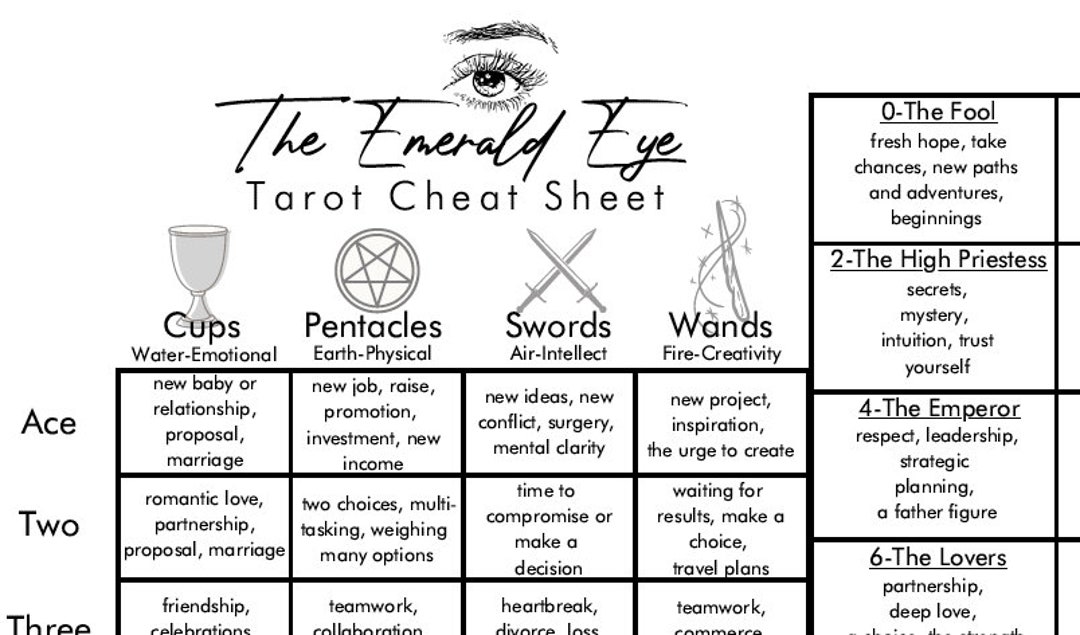
Imagine holding a deck of 78 mysterious cards, each whispering secrets from the cosmos, the subconscious, and the collective human experience. A tarot cheat sheet is your Rosetta Stone—a compact, powerful tool that decodes these whispers into clear, actionable insights. Think of it as a treasure map where X marks the spot of hidden truths, or a cheat code unlocking the game of life itself. Unlike memorizing dense guidebooks, a well-designed cheat sheet distills centuries of esoteric wisdom into bite-sized, visually intuitive snippets. It’s not just a crutch for beginners; even advanced readers use these sheets to jog their memory during readings or to explore new decks with unfamiliar symbolism. The beauty lies in its adaptability—whether you prefer minimalist keywords, poetic phrases, or full-blown narratives, your cheat sheet can be as unique as your spiritual fingerprint.
Decoding the Major Arcana: The Hero’s Journey in 22 Steps
The Major Arcana is the tarot’s grand narrative, a 22-card saga that mirrors the human experience from innocence to enlightenment. Each card is a chapter in the hero’s journey, packed with archetypal energy that resonates across cultures and centuries. The Fool’s leap into the unknown, the Lovers’ union of opposites, the Tower’s sudden collapse—these aren’t just static images; they’re dynamic forces shaping our lives. A cheat sheet for the Major Arcana should highlight the card’s core message, its astrological or elemental correspondence, and its “plot twist” potential (e.g., the Death card’s transformation, not literal demise). For example, The High Priestess might be labeled “Intuition, Mystery, Hidden Knowledge” with a note about her connection to the moon and the subconscious. Pair this with a mnemonic device—like associating The Magician with “manifestation” because he wields all four suits—to cement these meanings in your mind. The key is to see the Major Arcana not as isolated symbols, but as a living story where each card influences the next, creating a tapestry of fate and free will.
Navigating the Minor Arcana: The Everyday Magic of 56 Cards
If the Major Arcana is the tarot’s epic poem, the Minor Arcana is its daily newspaper—packed with the mundane, the emotional, and the unexpected moments that fill our lives. Divided into four suits (Wands, Cups, Swords, Pentacles), each corresponds to an element (fire, water, air, earth) and a realm of human experience. A cheat sheet for the Minor Arcana should break down the suits’ themes: Wands for passion and creativity, Cups for emotions and relationships, Swords for intellect and conflict, Pentacles for material world and practicality. Within each suit, the numbered cards (Ace through 10) follow a narrative arc—from potential (Ace) to fulfillment (10), with court cards (Page, Knight, Queen, King) representing people or personality traits. For instance, the 3 of Cups might be labeled “Celebration, Friendship, Joy” with a note about its watery, emotional depth. To make these cards memorable, link them to personal experiences: Have you ever felt the fiery ambition of the 5 of Wands during a creative project? Or the grounding stability of the 6 of Pentacles when helping a friend financially? The Minor Arcana becomes a mirror reflecting your own life’s dramas and triumphs.

Reversed Cards: When the Universe Says ‘Not So Fast’
Reversed cards are the tarot’s way of adding nuance, tension, or delay to a reading. They’re not inherently “bad”—think of them as plot twists in a story, where the energy of the card is internalized, blocked, or expressed in a less obvious way. A cheat sheet for reversed cards should focus on the card’s shadow side or its potential for growth. For example, the reversed Three of Cups might indicate loneliness or a lack of celebration, while the reversed Knight of Swords could signal impulsiveness or burnout. The trick is to avoid binary interpretations (good/bad) and instead ask: *How is this energy manifesting in my life right now?* Is the reversed The Emperor a sign of overbearing control, or a call to reclaim your personal power? The beauty of reversed cards is that they force you to dig deeper, turning a simple “yes” or “no” into a rich, multi-layered conversation with the cards. Use your cheat sheet to note keywords for reversals (e.g., “blocked,” “internalized,” “delayed”) and pair them with the upright meaning to create a fuller picture.
Crafting Your Personalized Cheat Sheet: A Mirror of Your Soul
The most powerful cheat sheet is the one you create yourself. While pre-made sheets offer convenience, designing your own forces you to engage with the cards on a deeper level. Start by selecting a format that resonates with you—whether it’s a grid, a mind map, flashcards, or a digital app. For each card, write down the meaning that speaks to you, using your own words and associations. Include personal anecdotes: Have you drawn The Star during a moment of hope? Did The Devil appear when you felt trapped in a toxic habit? Add visual elements like colors, symbols, or even doodles that reflect your intuition. You might also incorporate correspondences that matter to you, such as numerology, astrology, or chakra associations. For example, if you’re drawn to the number 7’s spiritual significance, note that The Chariot (VII) represents victory through discipline. The goal isn’t perfection—it’s to create a tool that feels like an extension of your mind, a cheat sheet that grows and evolves with your spiritual journey.
From Cheat Sheet to Mastery: Turning Knowledge into Intuition
A cheat sheet is just the beginning. True mastery comes when the cards’ meanings become second nature, when you can glance at a spread and instantly “feel” the energy of each card without consulting your notes. To bridge this gap, practice daily. Pull a single card each morning and journal about its message in your life. Use your cheat sheet as a springboard, but don’t rely on it—let the cards speak to you directly. Over time, you’ll notice patterns: The recurring appearance of Swords might signal a need to cut through illusions, while Pentacles could indicate a focus on stability. You’ll also develop your own “style” of reading, blending traditional meanings with your unique perspective. Remember, the tarot is a conversation, not a test. Your cheat sheet is your guide, but your intuition is the compass. Trust yourself to interpret the cards in a way that resonates with your truth.
Conclusion
A tarot cheat sheet is more than a quick reference—it’s a gateway to unlocking the tarot’s profound wisdom in a way that’s accessible, personal, and empowering. Whether you use a pre-made sheet or craft your own, the key is to engage with the cards actively, not passively. Let the Major Arcana guide you through life’s grand themes, let the Minor Arcana illuminate your daily experiences, and let reversed cards add depth and complexity to your readings. As you internalize the meanings, your cheat sheet will fade into the background, replaced by an intuitive understanding that feels almost magical. The tarot is a tool, but it’s also a mirror—reflecting back to you the stories, lessons, and truths that shape your journey. With your cheat sheet in hand, you’re not just learning the cards; you’re learning to speak their language, to dance with the universe’s symbols, and to find clarity in the midst of life’s mysteries.
FAQ
What is the purpose of a tarot cheat sheet?
The purpose of a tarot cheat sheet is to provide a quick and easy reference for understanding the meanings of tarot cards.
Can advanced readers use a tarot cheat sheet?
Yes, advanced readers can use cheat sheets as a quick reference to jog their memory or explore new decks.
Leave a Reply