Short Answer
Welcome to this comprehensive guide on The Tree of Life and The Tree of Life in Kabbalah. Whether you’re exploring spiritual symbolism, historical significance, or scientific interpretations, this article will provide a deep dive into the various dimensions of these profound concepts. You’ll discover their meanings across different traditions, their representations in art and science, and their enduring relevance in modern thought. By the end, you’ll have a well-rounded understanding of how these trees serve as bridges between the physical and metaphysical worlds.
The Tree of Life: An Overview
The Tree of Life is one of the most iconic and multifaceted symbols in human history, appearing in diverse cultures, religions, and philosophical systems. At its core, the Tree of Life represents interconnectedness, growth, and the cyclical nature of existence. It symbolizes the idea that all life is connected through a universal web of energy, knowledge, and divine presence. In many traditions, the tree is seen as a living entity that bridges the earthly and spiritual realms, offering wisdom, sustenance, and enlightenment to those who seek it.
Visually, the Tree of Life is often depicted as a large tree with spreading branches and deep roots, symbolizing the connection between heaven and earth. The branches reach upward toward the divine, while the roots delve deep into the earth, grounding the tree in the material world. This duality reflects the balance between the spiritual and physical aspects of life, emphasizing harmony and unity. The tree’s fruit, leaves, and flowers are also rich in symbolism, often representing abundance, healing, immortality, and the fruits of spiritual labor.
The Tree of Life in Kabbalah: A Mystical Perspective
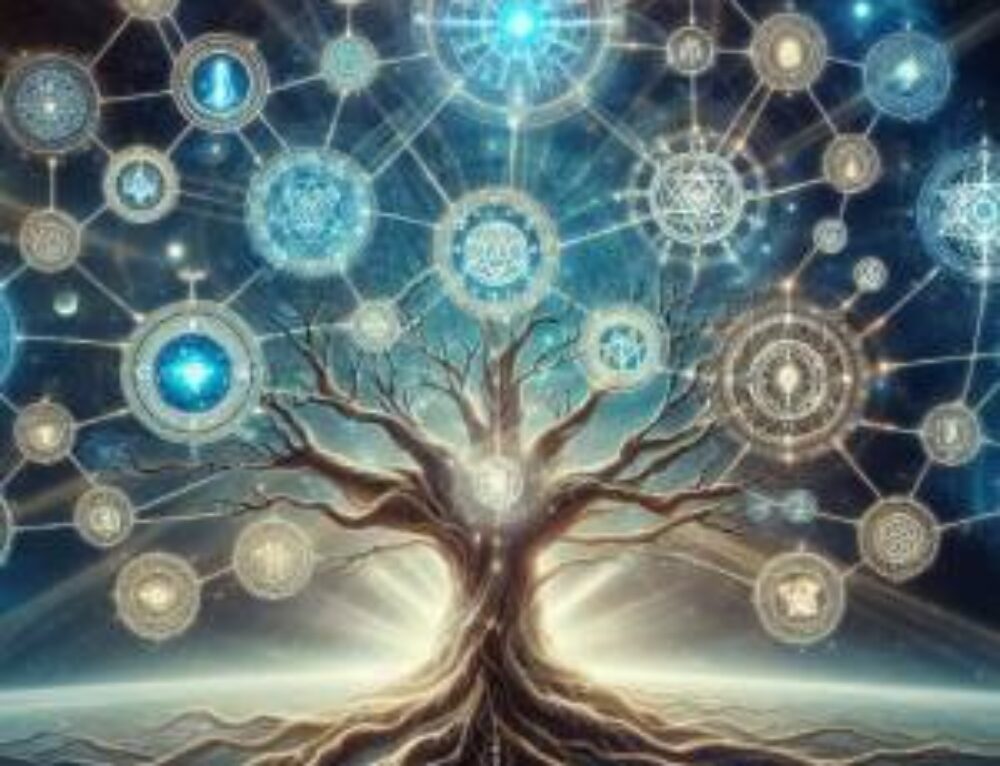
In Kabbalah, the Jewish mystical tradition, the Tree of Life takes on a deeply esoteric and structured form known as the Sephirotic Tree. This tree is not a physical entity but a symbolic diagram of divine emanations, or Sephirot, which represent the attributes of God and the pathways through which divine energy flows into the created world. The Sephirotic Tree consists of ten Sephirot arranged in three vertical columns, connected by 22 paths, forming a map of spiritual evolution and cosmic order.
The Sephirot are often visualized as spheres of light, each embodying a unique aspect of the divine, such as wisdom (Chokmah), understanding (Binah), and beauty (Tiferet). The paths between them represent the journey of the soul as it ascends toward enlightenment, encountering challenges, lessons, and transformations along the way. The Tree of Life in Kabbalah is not merely a static symbol but a dynamic framework for understanding the nature of reality, the purpose of existence, and the relationship between the finite and infinite.
For practitioners of Kabbalah, meditating on the Tree of Life can serve as a tool for spiritual growth, self-discovery, and alignment with divine will. It is also used in rituals, talismans, and sacred geometry to invoke specific energies or intentions. The Tree of Life in Kabbalah is a testament to the intricate interplay between the seen and unseen worlds, offering a roadmap for navigating the complexities of life with wisdom and grace.
Scientific Interpretations: The Tree of Life in Biology
Beyond its spiritual and mystical dimensions, the Tree of Life also holds significant meaning in the field of biology. In evolutionary biology, the Tree of Life is a metaphorical representation of the evolutionary relationships among all living organisms. This concept traces back to Charles Darwin’s theory of common descent, which posits that all species are descended from a single ancestral lineage, branching out over millions of years into the vast diversity of life we see today.
The biological Tree of Life is depicted as a branching diagram, with each branch representing a species or group of species. The trunk symbolizes the earliest life forms, while the branches and twigs represent the myriad of species that have evolved over time. This tree illustrates how all organisms are interconnected through shared ancestry, highlighting the unity of life on Earth. Advances in genetics and molecular biology have further refined this concept, allowing scientists to trace evolutionary relationships with greater precision and uncover the genetic links between seemingly unrelated species.

The Tree of Life in biology underscores the idea that life is a continuous, ever-branching process, with each species playing a unique role in the web of existence. It also serves as a reminder of humanity’s place within the natural world, emphasizing our shared heritage with all living beings. By studying this tree, scientists gain insights into the origins of life, the mechanisms of evolution, and the interconnectedness of ecosystems.
Cultural and Historical Significance of the Tree of Life
The Tree of Life is not confined to a single culture or tradition; it appears in various forms across the globe, each carrying its own unique symbolism and significance. In ancient Mesopotamian mythology, the Tree of Life was a symbol of immortality and divine knowledge, often associated with the goddess Ishtar. In Egyptian mythology, the tree was linked to the goddess Nut, who was believed to stretch her body across the sky like a tree, offering protection and sustenance to the living.
In Norse mythology, the Tree of Life is known as Yggdrasil, the great ash tree that connects the nine realms of existence. Yggdrasil is a central symbol in Norse cosmology, representing the cycle of life, death, and rebirth. Its roots delve into the underworld, its trunk spans the mortal realm, and its branches reach into the heavens, embodying the interconnectedness of all things. Similarly, in Hindu tradition, the Tree of Life is represented by the Kalpataru, a wish-fulfilling divine tree that grants blessings to those who honor it.
In many indigenous cultures, the Tree of Life symbolizes the harmony between humans and nature. It is often depicted in art, folklore, and sacred rituals as a source of wisdom, healing, and spiritual nourishment. For example, in Celtic tradition, the Tree of Life is known as Crann Bethadh, a symbol of strength, wisdom, and the eternal cycle of life. Its interwoven branches and roots represent the interconnectedness of all beings and the cyclical nature of existence.
The Tree of Life in Art and Literature
The Tree of Life has inspired countless works of art, literature, and music, serving as a powerful metaphor for growth, resilience, and transcendence. In visual art, the tree is often depicted in intricate patterns, sacred geometries, and symbolic representations that convey its spiritual and philosophical meanings. For instance, the Tree of Life appears in stained glass windows of Gothic cathedrals, Islamic geometric patterns, and Native American beadwork, each reflecting the cultural values and beliefs of its creators.
In literature, the Tree of Life is a recurring motif that symbolizes the journey of the hero, the search for enlightenment, and the quest for immortality. One of the most famous examples is J.R.R. Tolkien’s The Lord of the Rings, where the Two Trees of Valinor represent the light of the world and the hope of rebirth. Similarly, in Gabriel García Márquez’s One Hundred Years of Solitude, the Tree of Life is a symbol of the cyclical nature of time and the interconnectedness of generations.
In music, the Tree of Life has been immortalized in compositions that evoke its themes of growth, struggle, and transcendence. For example, the song The Tree of Life by the band Tool explores the Kabbalistic Tree of Life as a metaphor for personal and spiritual evolution. The tree’s symbolism also appears in classical works, such as Richard Wagner’s Ring Cycle, where the World Ash Tree (Yggdrasil) plays a central role in the narrative.
Practical Applications: How to Connect with the Tree of Life
The Tree of Life is not just a symbol to be admired from afar; it is a living concept that can be integrated into daily life for spiritual growth, healing, and self-discovery. One way to connect with the Tree of Life is through meditation and visualization. By visualizing the tree in your mind’s eye, you can align yourself with its energy, drawing strength from its roots and wisdom from its branches. This practice can help you cultivate a sense of grounding, clarity, and purpose.
Another practical application is the creation of a personal Tree of Life, either through art, journaling, or ritual. You can draw or paint your own version of the tree, incorporating symbols, colors, and elements that resonate with your spiritual journey. Alternatively, you can write about the aspects of your life that you wish to nurture and grow, much like the branches of a tree. This exercise can serve as a powerful tool for self-reflection and intention-setting.
In Kabbalah, the Tree of Life is often used in rituals and ceremonies to invoke specific energies or intentions. For example, you can meditate on a particular Sephirah (divine attribute) to cultivate its qualities in your life, such as love, strength, or wisdom. You can also use the Tree of Life as a framework for setting goals and tracking your spiritual progress, much like the branches of a tree that grow and evolve over time.
Conclusion
The Tree of Life is a timeless symbol that transcends cultural, spiritual, and scientific boundaries, offering a profound lens through which to view the world and our place within it. Whether explored through the mystical lens of Kabbalah, the empirical lens of biology, the artistic lens of literature and art, or the personal lens of meditation and ritual, the Tree of Life remains a powerful and versatile symbol of interconnectedness, growth, and transcendence.
As you reflect on the various dimensions of the Tree of Life, consider how its symbolism resonates with your own journey. How can you incorporate its lessons into your life? Whether you seek spiritual enlightenment, scientific understanding, or artistic inspiration, the Tree of Life offers a rich tapestry of wisdom to explore. By embracing its teachings, you can cultivate a deeper connection to yourself, to others, and to the universe as a whole.
FAQ
What is the Tree of Life?
The Tree of Life is a symbol representing interconnectedness, growth, and the cyclical nature of existence, found in various cultures and traditions.
How is the Tree of Life interpreted in Kabbalah?
In Kabbalah, the Tree of Life is a diagram of divine emanations known as Sephirot, representing the attributes of God and the pathways of spiritual evolution.
What does the Tree of Life symbolize in biology?
In biology, the Tree of Life represents the evolutionary relationships among living organisms, illustrating their common ancestry.
Leave a Reply