Short Answer
Overview
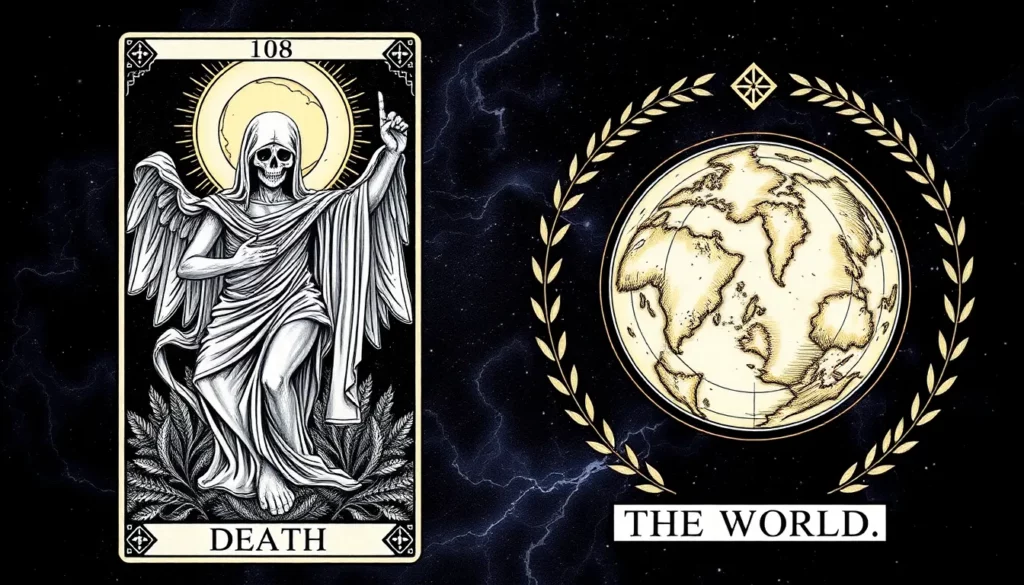
The combination of the Death and The World cards in tarot is a powerful symbol representing transformation, closure, and the successful completion of a significant life phase. Death, often misunderstood, typically signifies the end of a particular cycle or way of being, paving the way for renewal and change. The World card symbolizes fulfillment, wholeness, and the achievement of a long-term goal or spiritual completion. Together, these cards indicate that an ending (Death) is necessary to reach a state of completion or integration (The World).
History / Background
Both Death and The World are Major Arcana cards, originating from traditional tarot decks that emerged in 15th-century Europe. The Major Arcana cards represent significant archetypal energies and life lessons. Over time, their interpretations have evolved through various tarot traditions, including the Rider-Waite-Smith deck, which has greatly influenced modern tarot reading. The interplay between Death and The World has been recognized by tarot scholars and practitioners as a narrative of transformation followed by integration, reflecting broader themes of cycles in life, death, and rebirth.
Importance and Impact
The Death and The World combination holds substantial significance in tarot readings related to personal growth, spiritual development, and major life transitions. It encourages individuals to embrace necessary endings and transformations with the understanding that these lead to new opportunities and eventual fulfillment. The presence of these cards together can help people confront fears around change and mortality, offering a framework for understanding life’s cyclical nature. This combination has also influenced popular culture and psychological interpretations of tarot as tools for insight and healing.
Why It Matters
For contemporary tarot readers and querents, the Death and The World combination offers practical guidance for navigating periods of significant change. It reassures that while endings may be challenging, they are essential for growth and achieving a sense of completeness. Recognizing this card pairing can provide clarity during moments of uncertainty, helping individuals make conscious decisions about transitions, whether they involve relationships, careers, or personal identity. This combination underscores the importance of acceptance, resilience, and forward movement.
Common Misconceptions
The Death card always predicts literal death.
In tarot, the Death card primarily symbolizes transformation and endings, not physical death.
The World card means no further growth is possible.
The World card represents completion of a cycle but also the potential for new beginnings and continued evolution.
FAQ
Does the Death card always mean physical death?
No, the Death card typically symbolizes transformation, endings, and the clearing away of old patterns in preparation for new beginnings, rather than literal physical death.
What does The World card signify in a tarot reading?
The World card signifies completion, fulfillment, and the successful conclusion of a journey or cycle. It often indicates harmony and integration.
What is the significance of combining Death and The World cards?
Combining these cards emphasizes the process of ending a phase (Death) that leads to a sense of wholeness and achievement (The World), highlighting transformation followed by completion.
Leave a Reply