Short Answer
The Justice tarot card, often defined by its balanced scales and poised figure, serves as an archetype of fairness, truth, and accountability. In the realm of tarot, it invites introspection about moral integrity and the consequences of one’s actions. When considering the Justice card as a harbinger of yes or no, the interpretation can delve into multifaceted layers of meaning, each resonating with the spectrum of human experience. The Justice tarot card elicits a metaphysical exploration of ethics and decision-making, which enriches its appeal.
Symbolism of the Justice Card
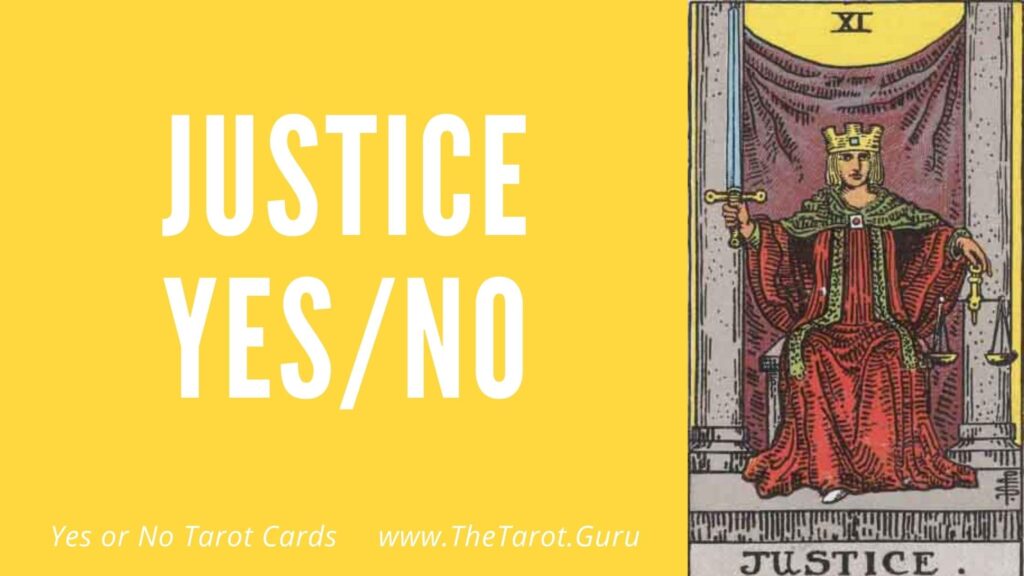
At first glance, the Justice card is rife with symbolism. The central figure, often depicted as a regal woman, embodies authority and impartiality. Clad in a gown that exudes strength, she holds the scales of justice delicately in one hand while wielding a sword in the other. This dichotomy is telling—all actions bear consequences, and within the realm of choice lies a quest for equilibrium. The sword signifies the ability to cut through deception and uncover truth, while the scales remind us of the delicate balance between good and evil, right and wrong.
Justice as a Guiding Principle
The essence of justice crystallizes in its capacity to serve as a moral compass. In a yes-or-no reading, the appearance of the Justice card suggests a tightrope walk between decision-making and ethical clarity. Its presence nudges querents toward reflection on their motives. Are one’s desires in alignment with ethical standards? Or does the pursuit of personal ambition cloud the judgment? The Justice card beckons you to contemplate the implications of your forthcoming choices.
Yes or No Interpretations
When the Justice card emerges in a spread, it can tilt the balance in two distinct directions depending on the circumstances surrounding the inquiry. A positive outcome inclined towards ‘yes’ may suggest that the querent’s case or endeavor is just, hence aligned with universal laws and fairness. In stark contrast, the card may also lend an affirmative nod to the notion that one’s moral fortitude is sound, and truth will ultimately prevail.
Conversely, if querying about a decision that lacks clarity or fairness, the Justice card may serve as a firm grip on the brakes, delivering a ‘no’ that feels authoritative and resolute. It may imply that the current situation is rife with imbalance or injustice, urging a moment of reckoning before proceeding.
Exploration of Consequences
The intricate fabric of consequences is woven throughout the Justice card’s counsel. A decision made with integrity, even if it yields short-term dissatisfaction, often leads to long-term fulfillment and harmony. Just as a house built on solid foundations withstands the ravages of time, decisions rooted in fairness and transparency tend to yield lasting positive effects. Hence, the Justice card’s presence may elevate the importance of exercising not only reason but also instinct when accumulating evidence necessary for a well-rounded judgment.
The repercussions of choices may reverberate far beyond the immediate horizon. It is easy to envision choices as singular, confined decisions rather than threads in the broader tapestry of one’s life—a realization that the Justice card ardently elucidates. Therefore, as one weighs ‘yes’ against ‘no’, it becomes incumbent to consider the long-standing implications, both for oneself and for those affected by the decision.
Justice and Personal Accountability
Intriguingly, the Justice card also emphasizes accountability and responsibility. It compels the querent to scrutinize their role in unfolding narratives. Are you the architect of your fate, or have you been an unwilling participant in the circumstances that led to your inquiry? Reconciling with personal accountability is an empowering exercise. The Justice card beckons individuals to embrace ownership of their choices, thus fostering a sense of inner strength.
The introspective journey spurred by Justice lays the groundwork for ethical development. It enhances emotional maturity and self-awareness, allowing individuals to journey toward a more refined understanding of right and wrong. This metamorphosis often facilitates a shift from merely existing to participating actively in one’s destiny.
Past, Present, and Future Dynamics
The contextual application of the Justice card can illuminate the past, present, and future dynamics of any situation. It may reference unresolved karmic debts or past actions that necessitate attention. When approaching dilemmas, one may find that choices, even if made in earnest, can be fraught with complexities that need elucidation.
In the present context, the Justice card often urges individuals to assess their current engagements critically. Decisions made under duress or emotion may not be reflective of one’s authentic values—this is where Justice intervenes with its unwavering insistence on exploration and reflection.
Looking toward the future, the Justice card can proffer profound insights into how forthcoming choices may resonate. Should one opt for fairness and honesty, the future may reveal a landscape ripe with constructive outcomes. Alternatively, if shrouded in deceit, a more tumultuous path might lie ahead. The proverbial scales may sway, delineating paths toward constructive development or challenging repercussions.
Conclusion
The Justice tarot card transcends a mere icon within your deck; it serves as an ethereal guide, prompting introspection into morality and personal accountability. In a yes-or-no reading, its relevancy cannot be understated. The Justice card implores you to be vigilant about the choices you make and their far-reaching impact, inviting you to embrace a holistic understanding of fairness, truth, and responsibility. Thus, wielding the wisdom of Justice transforms not just the present moment, but the very essence of one’s soul journey.
FAQ
What does the Justice tarot card represent?
The Justice tarot card represents fairness, truth, and accountability in decision-making.
How should I interpret the Justice card in a yes-or-no reading?
In a yes-or-no reading, the Justice card can indicate a 'yes' if the situation is just, or a 'no' if there is imbalance or injustice.

Leave a Reply