Short Answer
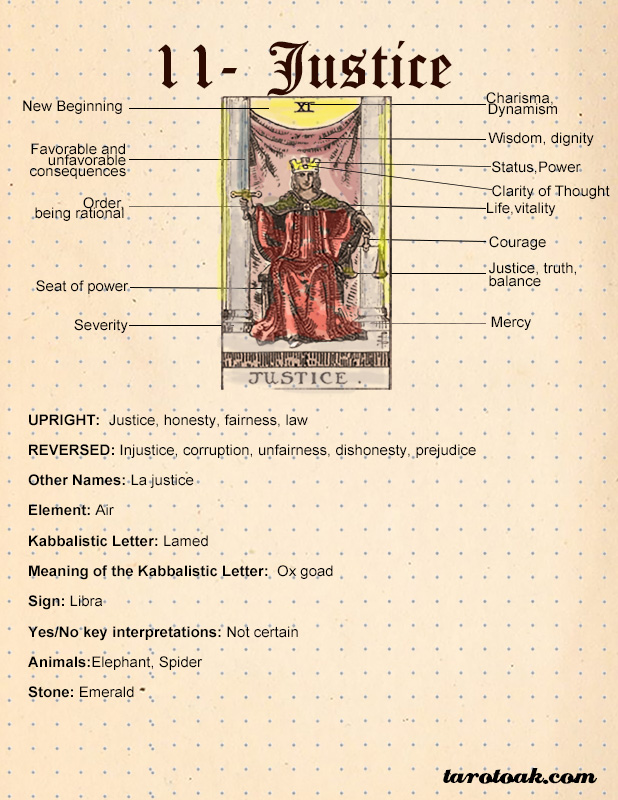
When one encounters the Justice tarot card in an upright position, it invokes a sense of equilibrium and clarity, acting as a beacon for moral reflection. The Justice card, often depicting a robed figure holding a set of scales and a sword, serves as a powerful symbol of fairness and truth. In exploring its meanings, it becomes evident how profoundly this card resonates with our collective psyche, imbuing our understanding of ethics, responsibility, and accountability with deeper dimensions.
The Justice card resonates particularly with the fundamental principle of balance. It often appears when an individual grapples with ethical dilemmas or conflicts requiring impartiality. In daily life, instances arise where one is confronted with the choice between self-interest and the welfare of others. This card prompts introspection, compelling individuals to weigh their decisions carefully. Do they align with personal values, or do they tread the treacherous waters of moral ambiguity?
Central to the Justice card’s upright position is its function as an arbiter—encouraging one to adhere to principles of fairness not only for others but also for oneself. It suggests a reflective pause, urging individuals to consider their actions in relation to their consequences. This exploration of cause and effect taps into a universal longing for equilibrium, making the card appealing and thought-provoking. As one contemplates social justice and personal integrity, the Justice card embodies the ideals many strive for in life.
Furthermore, Justice invokes the notion of accountability. In various life pursuits, whether personal relationships, careers, or social circles, individuals often elude responsibility. Encountering the Justice card may signify a necessary confrontation with one’s own part in a situation, prompting an individual to take responsibility for their actions. This call to vigilance can lead to transformative realizations, uncovering hidden motivations and revealing profound truths. The journey within oneself, sparked by the Justice card, can elucidate the transformative power of taking ownership of one’s life.
Justice also manifests as the inevitability of consequences. The scales symbolize the weighing of actions against their repercussions, whether they be beneficial or detrimental, and that fate has a way of balancing the scales in unforeseen ways. Especially in a time dominated by quick fixes and superficial resolutions, the Justice tarot card serves as a reminder of the enduring nature of truth. The universe operates on laws that do not favor the dishonest; thus, authenticity and integrity are necessary virtues in navigating life’s complexities.
Another critical aspect of the upright Justice card is its emphasis on objective judgment. This card encourages one to view situations from multiple perspectives, thereby enhancing one’s understanding and leading toward a fair outcome. This aspect is essential not only for personal growth but also for interpersonal relationships. By learning to step outside of one’s biases and preconceptions, individuals can cultivate a more profound compassion and empathy for others, allowing for harmonious coexistence within diverse social fabrics.
Moreover, Justice wields the sword not just as a tool of enforcement but also as a representation of clarity and decisiveness. It invites individuals to cut through deceit and disillusionment, urging them to pursue the truth relentlessly. Societal tendencies to distort facts or engage in self-deceit can stifle progress; hence, the Justice card advocates for transparency and honesty as prerequisites for realizing true potential. It insists that confronting uncomfortable truths is preferable to existing in ignorance.
In a broad societal context, the appearance of the Justice card can reflect larger collective issues—social justice, equality, and community responsibility. In many interpretations, the card serves as a rallying cry for those involved in activism and reform. It emphasizes that one’s actions extend beyond personal implications, affecting the community at large. Justice urges individuals to engage in the societal discourse actively, promoting fairness and inclusion. In this way, the card operates both on the personal plane and the broader societal level, further amplifying its allure.
The upright Justice card also plays a pivotal role in the realm of legal matters. Often viewed as a harbinger of judicial affairs, it symbolizes fairness in court proceedings and the correct administration of justice. It suggests that the truth will emerge, and fairness will prevail, an inherently reassuring message for those tangled in legal entanglements. This particular association has incited fascination in those who find themselves in challenging legal circumstances, providing an ounce of hope amid turmoil.
Ultimately, the Justice tarot card—in its upright position—offers an insightful exploration into the intricate tapestry of morality, accountability, and fairness. Its multifaceted symbolism serves as a digest for self-reflection and societal interaction. As individuals navigate their personal paths, they may often seek the illumination provided by this card, becoming more attuned to the necessity of balance within and around them.
In conclusion, the upright Justice card transcends mere divinatory insights; it emerges as an essential reminder—a call for fairness, a herald of accountability, and an advocate for the truth. The deep-rooted fascination it ignites stems from humanity’s continuous quest for balance in an oftentimes chaotic world, encouraging individuals to live authentically and judiciously. Each encounter with the Justice card offers not just guidance, but also an invitation to partake in the noble pursuit of a just and equitable existence.
FAQ
What does the Justice card mean when drawn upright?
When drawn upright, the Justice card signifies a strong sense of balance and moral clarity, encouraging fairness in decision-making.
How does the Justice card relate to personal responsibility?
The Justice card emphasizes the importance of accountability, urging individuals to confront their actions and their consequences.

Leave a Reply