Short Answer
Welcome to your comprehensive guide on the Visconti Sforza Booklet – The Original Meanings. This resource is designed to provide deep insights into one of the most historically significant tarot decks in existence. Whether you’re a seasoned tarot enthusiast, a historian, or simply curious about Renaissance-era symbolism, this guide will illuminate the rich tapestry of meanings embedded in the Visconti Sforza deck. You’ll explore its origins, the significance of its cards, the artistic and cultural context, and how its interpretations have evolved over centuries. By the end, you’ll have a thorough understanding of why this deck remains a cornerstone of tarot studies.
The Historical Significance of the Visconti Sforza Deck
The Visconti Sforza tarot deck is not just a collection of beautifully illustrated cards; it is a historical artifact that offers a window into 15th-century Italy. Commissioned by the Duke of Milan, Francesco Sforza, and possibly designed by Bonifacio Bembo, this deck is one of the oldest surviving tarot decks in the world. Created between 1440 and 1450, it was originally intended as a luxury item for the aristocracy, reflecting the political and social dynamics of the Visconti-Sforza family. Unlike later tarot decks, which were often used for divination, the Visconti Sforza was primarily a status symbol and a tool for noble entertainment. Its intricate artwork and gold leaf details highlight the craftsmanship of the era, making it a testament to Renaissance artistry.
The deck consists of 74 cards, including the 22 Major Arcana and 56 Minor Arcana, divided into four suits: Cups, Swords, Coins, and Batons. Each card is rich with allegorical imagery, blending medieval Christian symbolism with classical motifs. For example, the Chariot card features a knight in armor, symbolizing triumph and authority, while the Death card is depicted as a skeleton in armor, a stark reminder of mortality. These cards were not just for play; they were a visual language that conveyed moral lessons and political messages to the elite who commissioned them.
Understanding the Major Arcana: Archetypes and Symbolism
The Major Arcana of the Visconti Sforza deck is a sequence of 22 cards that represent life’s spiritual and psychological journey. Each card is a powerful archetype, embodying universal themes such as love, power, wisdom, and transformation. For instance, the Magician card is depicted as a figure holding a wand and a coin, symbolizing skill, resourcefulness, and the ability to manifest one’s will. In contrast, the Hermit card shows an old man holding a lantern, representing introspection, solitude, and the search for inner truth. These cards are not merely illustrations; they are visual metaphors that invite deeper contemplation.
One of the most intriguing aspects of the Visconti Sforza’s Major Arcana is its departure from later tarot traditions. For example, the Popess card (often called the High Priestess in modern decks) is depicted as a seated woman holding a book, a symbol of hidden knowledge and spiritual authority. This card’s presence in the Visconti Sforza deck underscores the deck’s connection to early Christian mysticism and the role of women in religious contexts. Similarly, the Tower card is illustrated with a falling figure, emphasizing sudden upheaval and divine intervention. These variations highlight how the deck’s original meanings were tailored to the cultural and religious milieu of 15th-century Italy.

The Minor Arcana: Suit Symbolism and Everyday Life
The Minor Arcana of the Visconti Sforza deck is divided into four suits—Cups, Swords, Coins, and Batons—each reflecting different aspects of human experience. The Cups suit, associated with emotions and relationships, features cards like the Ace of Cups, which depicts a hand pouring water from a golden chalice, symbolizing love, intuition, and spiritual nourishment. The Swords suit, tied to intellect and conflict, includes the Three of Swords, showing a heart pierced by three swords, representing heartbreak and sorrow. These suits are not just decorative; they mirror the joys, struggles, and complexities of daily life in Renaissance Italy.
The Coins suit, often linked to material wealth and practicality, includes cards like the King of Coins, illustrated as a nobleman holding a coin, symbolizing prosperity, stability, and leadership. Meanwhile, the Batons suit, associated with creativity and growth, features the Two of Batons, showing two figures holding a baton, representing partnership and collaboration. Unlike later tarot decks, which often simplify the Minor Arcana, the Visconti Sforza’s suits are rich with detail, offering nuanced insights into the social and economic structures of the time. For example, the Page of Coins is depicted as a young boy holding a coin, symbolizing potential, learning, and the beginning of a journey toward financial independence.
The Artistic and Cultural Context of the Deck
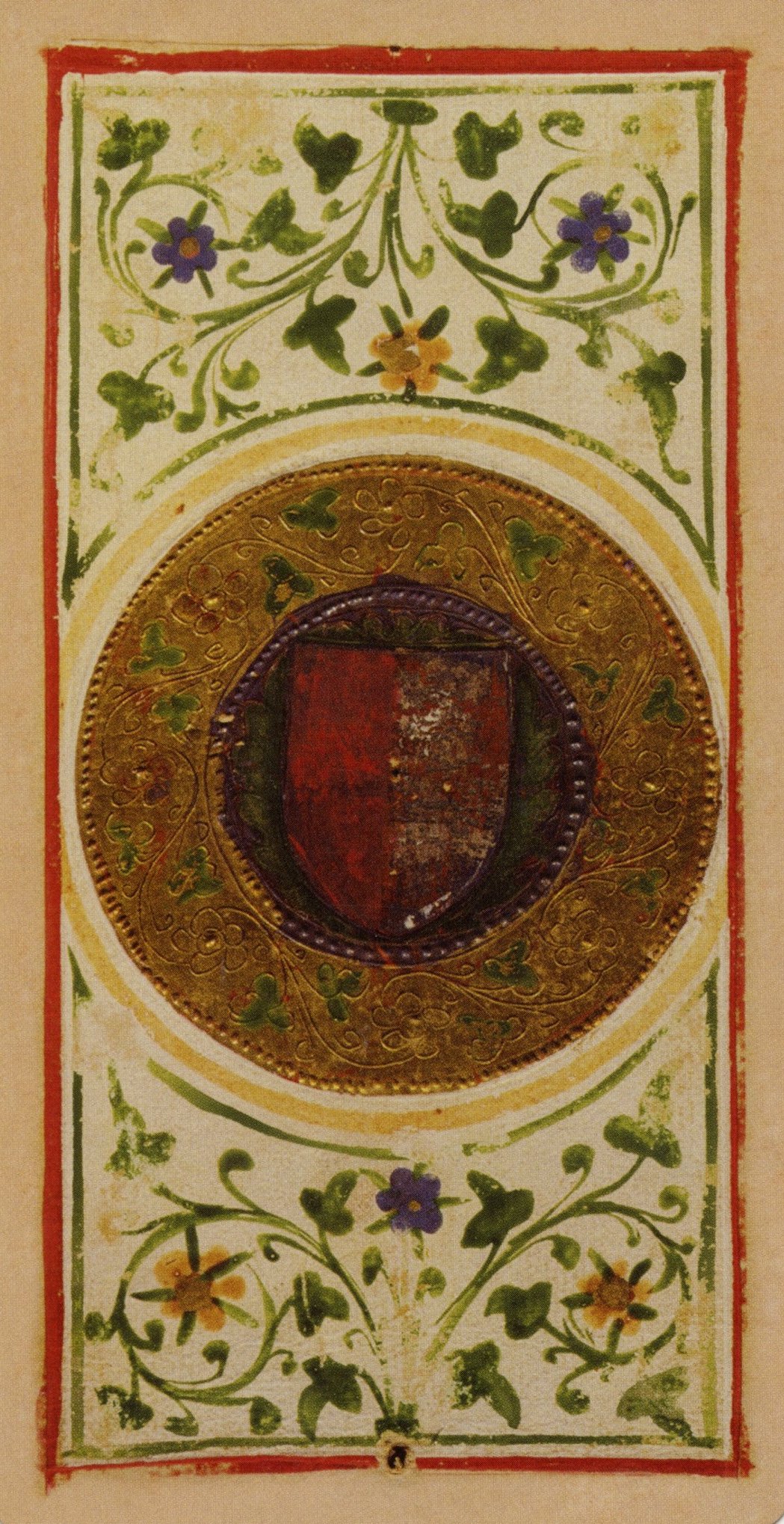
The Visconti Sforza deck is a masterpiece of Renaissance art, blending Gothic and early Renaissance styles. The cards are characterized by their vibrant colors, intricate patterns, and gold leaf embellishments, reflecting the opulence of the Sforza court. The artwork is attributed to Bonifacio Bembo, a renowned painter of the time, whose style is evident in the delicate brushwork and expressive figures. Each card is a miniature painting, filled with symbolic details that reward close examination. For instance, the World card features a crowned figure surrounded by a wreath, symbolizing completion, harmony, and cosmic unity. The background is adorned with zodiac symbols, linking the card to astrological traditions of the era.
The cultural context of the deck is equally fascinating. Created during a period of political intrigue and artistic innovation, the Visconti Sforza deck reflects the values and aspirations of the Milanese nobility. The cards were likely used in games like tarocchi, a popular pastime among the elite, but their symbolism also served as a visual language for conveying moral and philosophical ideas. The deck’s imagery draws from a mix of sources, including medieval bestiaries, Christian iconography, and classical mythology. For example, the Devil card is depicted as a horned figure with a woman and a man chained to its throne, a stark warning against temptation and moral corruption. This blend of sources makes the deck a fascinating study in the intersection of art, religion, and politics.
Comparing the Visconti Sforza to Modern Tarot Decks
While the Visconti Sforza deck is over 500 years old, its influence on modern tarot is undeniable. Many contemporary decks, such as the Rider-Waite-Smith and Thoth tarot, draw inspiration from the Visconti Sforza’s symbolism and structure. However, there are key differences that set the original deck apart. For example, the Strength card in the Visconti Sforza is depicted as a woman taming a lion with her bare hands, emphasizing inner power and compassion. In contrast, the Rider-Waite-Smith version shows a woman gently closing a lion’s mouth, reflecting a more subdued interpretation of strength. These variations highlight how tarot symbolism has evolved over time, adapting to changing cultural and spiritual values.
Another notable difference is the absence of some cards that are now standard in modern decks. The Visconti Sforza does not include the Fool or the Judgement card as they are known today. Instead, the deck’s sequence ends with the World card, symbolizing completion and wholeness. This difference underscores the deck’s original purpose as a game and a status symbol rather than a divination tool. Additionally, the Minor Arcana in the Visconti Sforza lacks the detailed scenes found in modern decks like Rider-Waite, instead focusing on symbolic imagery that requires deeper interpretation. Understanding these differences is crucial for appreciating the deck’s unique place in tarot history.
How to Use the Visconti Sforza Booklet for Study and Interpretation
The Visconti Sforza Booklet serves as a bridge between the deck’s historical context and its modern interpretations. When using the booklet, readers can expect a blend of historical analysis, symbolic breakdowns, and practical guidance for interpreting the cards. For example, the booklet might explain that the Hanged Man card, depicted as a figure hanging upside down from a tree, represents sacrifice, surrender, and a shift in perspective. The booklet may also provide insights into how the card’s meaning has shifted over time, from a symbol of martyrdom in Christian tradition to a metaphor for enlightenment in esoteric thought.
Readers can also expect the booklet to highlight the deck’s artistic details, such as the use of color, composition, and allegorical elements. For instance, the Moon card in the Visconti Sforza features a crescent moon with a face, surrounded by a dog and a wolf howling at it, symbolizing intuition, illusion, and the subconscious. The booklet might explain how these elements interact to create a cohesive narrative, encouraging readers to look beyond the surface and explore the deeper layers of meaning. Additionally, the booklet may include comparative tables or side-by-side images of the Visconti Sforza cards alongside their modern counterparts, helping readers trace the evolution of tarot symbolism.
Conclusion
The Visconti Sforza Booklet – The Original Meanings is more than just a guide to a tarot deck; it is an invitation to explore the intersection of art, history, and spirituality. By delving into the deck’s origins, symbolism, and cultural context, readers gain a deeper appreciation for its role as a historical artifact and a living tradition. Whether you’re drawn to the deck’s Renaissance artistry, its political intrigue, or its enduring influence on modern tarot, this guide provides the tools to unlock its secrets. The Visconti Sforza deck is a testament to the power of symbolism to transcend time, offering insights that remain relevant even centuries after its creation. As you study its cards, you’ll not only uncover the original meanings but also discover how these ancient symbols continue to resonate in the modern world.
FAQ
What makes the Visconti Sforza tarot deck unique among tarot decks?
Its combination of Renaissance artistry, gold leaf embellishments, and original symbolism distinct from later divinatory decks sets it apart.
Are all the traditional tarot cards present in the Visconti Sforza deck?
No, some cards like the Fool and Judgement as known today are absent or depicted differently.
How are the suits in the Visconti Sforza deck different from modern decks?
The suits retain symbolic imagery tied to Renaissance societal roles and lack the detailed narrative scenes common in modern decks.
Leave a Reply