Short Answer
Welcome to a journey through the mystical world of Tarot cards—a timeless tool for divination, self-reflection, and unlocking the hidden currents of fate. In this guide, you’ll uncover the profound meanings behind each card, explore how they weave together to reveal futures still unwritten, and discover why Tarot remains one of the most intriguing and enduring practices of spiritual insight. Whether you’re a seasoned reader or a curious beginner, prepare to see the cards not just as symbols, but as living metaphors that speak to the human experience in ways both poetic and revelatory.
The Essence of Tarot: More Than Just Cards
Tarot is far more than a deck of illustrated cards—it is a mirror to the soul. At its core, a Tarot deck consists of 78 cards divided into two main groups: the Major Arcana and the Minor Arcana. The Major Arcana, with its 22 cards, represents life’s grand themes—birth, death, love, transformation—each a chapter in the human story. The Minor Arcana, with 56 cards, mirrors the everyday events and emotions, offering nuanced insights into relationships, challenges, and opportunities. Together, they form a language of symbols that transcends time and culture, speaking directly to the subconscious mind.

What makes Tarot truly captivating is its ability to blend art, psychology, and spirituality into a single, cohesive narrative. Each card is a painting, a poem, a riddle—inviting interpretation and personal resonance. The imagery is rich with archetypes: the Fool’s leap into the unknown, the Lovers’ union of opposites, the Tower’s sudden collapse. These are not random pictures; they are mirrors held up to our deepest fears, desires, and truths. When shuffled and laid out in a spread, the cards don’t predict a fixed future—they illuminate the paths still open to us, guided by the wisdom of the present moment.
Major Arcana: The Soul’s Journey Unfolded
The Major Arcana cards are the heart of Tarot’s storytelling power. They depict a journey—often called the Fool’s Journey—beginning with The Fool (card 0) and culminating in The World (card 21). This progression mirrors the stages of human development: innocence, choice, struggle, revelation, and integration. For instance, The Magician (card I) symbolizes manifestation and resourcefulness, while The High Priestess (card II) represents intuition and hidden knowledge. Each card carries a lesson, a warning, or a blessing, depending on its position in a reading.
Consider The Hanged Man (card XII), often misunderstood as a symbol of stagnation. In truth, it speaks of surrender, new perspectives, and the wisdom found in pause. Or The Star (card XVII), a beacon of hope and inspiration, reminding us that even in darkness, guidance is near. These cards don’t just foretell events; they frame life’s challenges as opportunities for growth. They teach that the future is not a predetermined script but a living dialogue between choice and chance.
Minor Arcana: The Tapestry of Daily Life
While the Major Arcana maps the grand narrative of existence, the Minor Arcana delves into the details—the daily joys, struggles, and decisions that shape our lives. Divided into four suits—Wands, Cups, Swords, and Pentacles—each corresponds to an element and a facet of human experience. Wands, tied to fire, represent creativity, passion, and ambition. Cups, linked to water, embody emotions, relationships, and intuition. Swords, associated with air, signify intellect, conflict, and clarity. Pentacles, grounded in earth, reflect material wealth, health, and practicality.
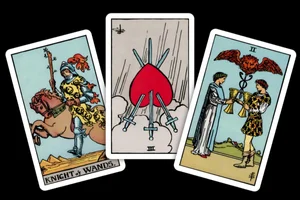
Take the Ace of Cups, for example—a card of emotional renewal and new beginnings in love or creativity. Or the Ten of Swords, often feared as a harbinger of doom, but which actually signals the end of a painful cycle and the dawn of recovery. The Minor Arcana teaches that even the most mundane moments carry symbolic weight. A Three of Pentacles might appear when you’re collaborating on a project, while a Knight of Wands could herald a sudden burst of inspiration or a reckless adventure. These cards remind us that the future is not a distant prophecy but a series of choices woven into the fabric of today.
Reading the Future: Still Unwritten, Yet Seen
One of Tarot’s most compelling paradoxes is its ability to reveal futures that are not yet set in stone. A skilled reader doesn’t predict a fixed outcome; instead, they illuminate the energies at play and the potential paths forward. For instance, drawing The Tower in a career reading might suggest upheaval—but it also opens the door to rebuilding on stronger foundations. The future, as seen through Tarot, is a landscape of possibilities, shaped by free will, intention, and the unseen currents of fate.
Spreads, or layouts of cards, are the language of this revelation. A simple three-card spread—Past, Present, Future—offers a linear narrative, while a Celtic Cross provides depth and complexity. Each position in a spread acts as a lens, focusing the reader’s attention on different aspects of a question. The cards don’t dictate; they converse. They ask: What fears are holding you back? Where does your intuition lead you? What hidden strengths can you claim? In this way, Tarot becomes a tool for empowerment, not prediction—a way to navigate life’s uncertainties with clarity and courage.
The Language of Symbols: Decoding the Unseen
Tarot’s power lies in its symbolism—a visual language that bypasses the rational mind to speak directly to the soul. Every element in a card, from colors to objects to figures, carries meaning. The golden crown of The Empress, for instance, signifies abundance and nurturing, while the crossed swords of The Two of Swords represent indecision and the need for clarity. Even the absence of an element can be telling: a card without a background sky might suggest confinement or a lack of perspective.
Colors are particularly evocative. Red, the color of passion and action, often appears in cards like The Chariot or The Six of Wands. Blue, associated with intuition and calm, dominates The High Priestess or The Star. The interplay of light and shadow in a card’s imagery can reveal hidden tensions or resolutions. For example, The Moon card, with its eerie glow and howling dog, reflects illusion and subconscious fears—but also the potential to face them. Learning to read these symbols is like learning a new dialect of the imagination, one that reveals truths words cannot express.
Tarot as a Mirror: Reflection, Not Prediction
Perhaps the most profound aspect of Tarot is its role as a mirror. It doesn’t show a future that is inevitable; it reflects the inner landscape of the querent—their hopes, fears, and unresolved questions. A reading can act as a catalyst for self-discovery, prompting the reader to confront what they already know but have yet to acknowledge. The cards don’t tell you what to do; they ask you to listen to your own wisdom.
For example, pulling The Hermit in a reading about a difficult decision might not mean you should isolate yourself, but rather that you need to seek solitude for clarity. The Ten of Cups, often called the “happily ever after” card, doesn’t guarantee a perfect life—it reminds you to cherish the love and joy already present. Tarot, at its best, is a conversation between the conscious and unconscious mind, a way to dialogue with the deeper self.
Conclusion: The Timeless Dance of Fate and Choice
Tarot cards are more than tools of divination; they are companions on the journey of life, offering insight, comfort, and a language to articulate the inexpressible. They teach us that the future is not a fixed destination but a living, breathing entity shaped by our choices, fears, and dreams. Whether you seek guidance, inspiration, or simply a deeper connection to the mysteries of existence, Tarot provides a path—one that is as poetic as it is practical.
As you explore the cards, remember: their power lies not in their ability to foretell, but in their capacity to illuminate. They don’t read the future; they help you write it. And in that act of creation, you become both the reader and the author of your own story.
FAQ
What are Tarot cards used for?
Tarot cards are used for divination, self-reflection, and providing insights into personal situations and future possibilities.
What is the difference between Major and Minor Arcana?
Major Arcana cards represent significant life themes and lessons, while Minor Arcana cards reflect everyday events and situations.
How do you read Tarot cards?
Reading Tarot involves interpreting the cards’ meanings based on their symbolism, position in a spread, and the question at hand.
Leave a Reply