Short Answer
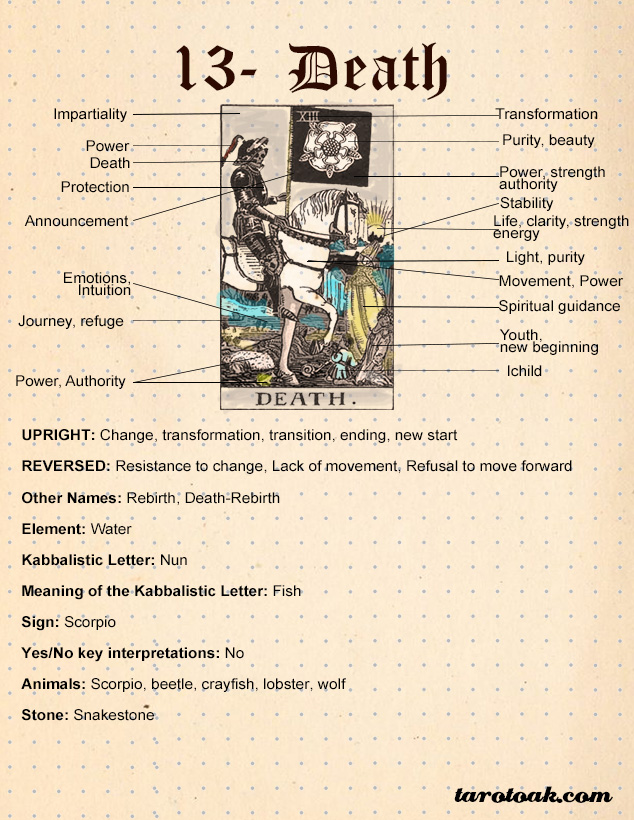
The Death card in a tarot deck often evokes a visceral reaction—picturing a skeletal figure, cloaked in somber garb, guiding souls to the afterlife. Yet, contrary to its grim exterior, the card embodies transformation, endings, and new beginnings. How might this translate into the realm of love from a Christian perspective? Can the message of the Death card facilitate growth and renewal in our romantic entanglements? This exploration seeks to answer such questions and pose a challenge: Can we view love as a series of transformations rather than a linear journey?
To unpack the meaning of the Death card, it is imperative first to understand its symbolism. Within Christian theology, death is not an end, but rather a transition. It reflects the resurrection of Christ and the promise of eternal life. In romantic contexts, the Death card can signify a relationship phase that has reached its conclusion, heralding the onset of something new. Herein lies the conundrum—how does one reconcile the human aversion to endings with the Christian ideal of hope and renewal?
The card’s association with transformation is profound. In the Bible, passages like Isaiah 43:18-19 illustrate God’s ability to create pathways in the wilderness, signifying new nascent opportunities. When applied to love, the Death card might symbolize the closure of stagnant relationships, paving the way for rekindled desire or new partnerships. It implores individuals to accept love’s ephemeral nature, prompting them to relinquish unhealthy bonds for the prospect of rejuvenation.
Christian doctrine invites adherents to embrace vulnerability in love, echoing themes of loss and rebirth. The analogy of Christ’s sacrifice reflects a paradox: through loss, we gain. This principle resonates with the Death card’s narrative. When one relationship falters or dissolves, it offers a fertile ground for personal growth and readiness for future endeavors. Therefore, rather than approaching heartbreak with despair, one might look through the lens of hope, seeking the lessons embedded in the dissolution.
Yet, let us contemplate this notion further. Have you ever found yourself trapped in a cycle of unrequited love or a toxic relationship? Recognizing when to let go can prove challenging. The Death card serves as a poignant reminder that sometimes, we must embrace endings. This can involve difficult conversations, painful separations, or introspective journeys. In Christian thought, this can be seen as a form of spiritual purification, where the act of letting go enables the soul to ascend to a higher understanding of love.
In the Christian narrative, love is both a divine gift and a responsibility. The essence of agape—selfless, unconditional love—challenges us to embrace others with grace. When the Death card surfaces in a love reading, it nudges individuals to question whether they are nurturing love or clinging desperately to past attachments. The challenge here lies in discerning when love has morphed into an impediment affecting personal and spiritual growth.
The juxtaposition of death and rebirth encapsulates a necessary cycle in the realm of love. Consider the story of Ruth in the Old Testament. Ruth’s loyalty to Naomi led her to abandon her homeland and seek a new life, which ultimately resulted in her becoming an ancestor of David. Her story reflects the idea that from loss and abandonment springs new opportunity—a theme resonant with the Death card. Ruth’s decision to forge a new path exemplifies profound courage, urging individuals to venture into unknown territories for the sake of genuine love.
Moreover, embracing the teachings of Jesus can provide solace when love gives way to endings. “Blessed are those who mourn, for they shall be comforted,” (Matthew 5:4) reminds us that grief carries with it the seeds of healing. The Death card similarly implores individuals to mourn lost relationships, to acknowledge the pain inherent in transformation. By permitting oneself to grieve, one cultivates resilience that is essential when entering new relationships or rekindling old flames.
In the context of relationships, the Death card signifies that embracing endings leads to fruitful beginnings. This is the transformational journey that love offers—a process rooted in faith and divine guidance. The Christian belief in redemption underlines the importance of hope. If love requires cultivating new beginnings, do the lessons learned render the experiences worthwhile? The intermingling of joy and sorrow propels one toward understanding self-worth and the capacity to love deeply.
Thus, the challenge posed by the Death card is significant: Are we ready to relinquish unhealthy attachments to embrace the full spectrum of love’s offerings? In doing so, one showcases an understanding that love is an evolving entity, much like faith—a living experience that shifts with every season. The Christian perspective amplifies this notion, rooting itself in the worship of renewal and the promise of eternal love.
In conclusion, the Death card within the tarot realm compels individuals to reflect on how love transforms through loss. When viewed through a Christian lens, the card encourages a profound appreciation for the arc of love: the necessity of endings paving the way for regenerative rebirth. Ultimately, recognizing love as an ongoing journey imbued with divine purpose fosters an enriched understanding of our connections, inviting hope and renewal into our hearts.
FAQ
What does the Death card symbolize in love?
The Death card symbolizes transformation, endings, and new beginnings in romantic relationships.
How can the Death card be interpreted from a Christian perspective?
From a Christian perspective, the Death card reflects the idea of hope and renewal, emphasizing that endings can lead to new opportunities and personal growth.
Leave a Reply