Short Answer
The Death tarot card, often met with trepidation, presents a nuanced reading when viewed through the lens of Christian theology. Its stark imagery and somber title may induce a sense of foreboding, but beneath the surface lies a wealth of interpretation, especially within the context of Christian beliefs. How might this card—typically associated with the end—actually signify renewal and transformation, challenging traditional notions of mortality and divine providence? This intriguing inquiry leads us to explore the multifaceted meanings embedded in the Death tarot card.
Initially, it’s important to recognize that the Death card is commonly misinterpreted as a harbinger of doom. Instead, it should be seen as an emblem of transitions. Just as Christians embrace the resurrection of Christ as a symbol of hope and rebirth, the Death card invites believers to contemplate the allure of change and the divine’s wisdom in orchestrating the cycles of existence. The biblical scripture Ecclesiastes 3:1 tells us, “To everything there is a season, and a time for every matter under heaven.” In this light, the Death card can be perceived as an encouragement to accept endings as a precursor to new beginnings.
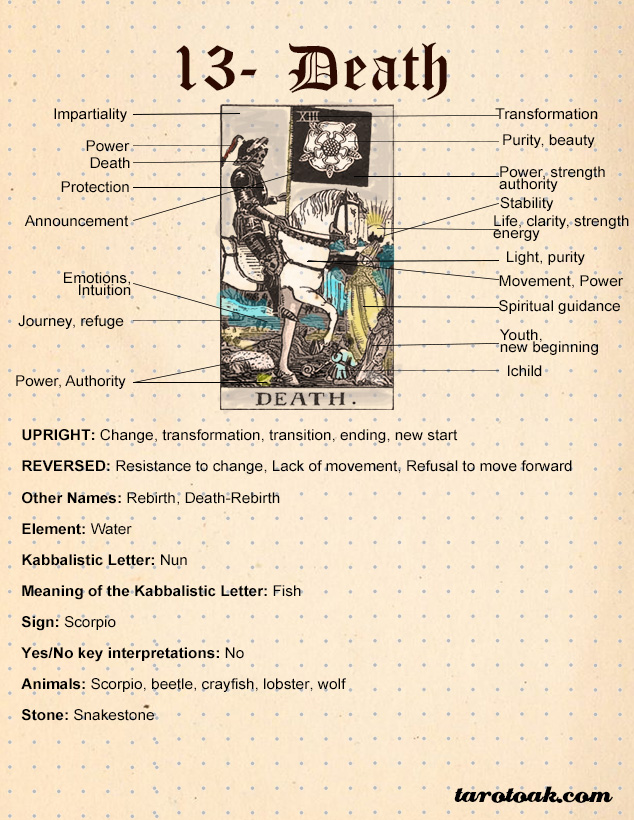
Delving deeper into the symbolism, the card often manifests as a skeletal figure riding a white horse, wielding a black flag. This representation of death is not a fearsome specter but a harbinger of transformation, reminiscent of the angel of death that played a pivotal role in the Biblical Exodus. In that narrative, the angel’s presence led to liberation and the birth of a new covenant for the Israelites. This symbolism resonates strongly with the Christian ethos of salvation, marking death as a vehicle for the promise of eternal life.
As Christians reflect on the concept of death through scripture, passages like 1 Corinthians 15:55 resonate profoundly: “Death, where is your victory? Death, where is your sting?” This rhetorical question captures the essence of Christian eschatology—the belief that life following death offers freedom from sin and suffering. By correlating these beliefs with the Death tarot card, one may glean that the end of one phase invariably paves the way for the inception of another, just as Christ’s resurrection ushered in hope for believers.
Moreover, the imagery of the Death card can also be likened to the theological concept of metanoia, or profound transformation. Metanoia encourages individuals to undergo a spiritual renewal, akin to a baptism—symbolically dying to the former self and emerging rejuvenated. This mirrors the transformative aspect of the Death card, proposing that one must surrender their old self to embrace growth. The challenge then arises: can one foster this intense journey of introspection without succumbing to fear? Are Christians prepared to face their own symbolic ‘deaths’ to evolve into a more enlightened state?
In addition to personal transformation, the Death card emphasizes the importance of communal perspectives on mortality. Within the Christian community, funerary practices and memorials provide crucial opportunities for collective mourning and healing. These rituals echo the idea that death is not simply an ending but a communal passage into different forms of existence—akin to the funeral rites reflecting Jesus’s own death and resurrection. The same principles can be applied to the Death card, suggesting that this “end” serves a more significant purpose both individually and collectively, pushing believers to reflect on their relationships with the divine and each other throughout their earthly journeys.
Furthermore, considering the historical context of the tarot provides additional layers to the conversation. Originating in medieval Europe, tarot cards often symbolized the human experience, oscillating between the profane and the sacred. Many of the allegories presented in the tarot were influenced by spiritualism and mysticism, which, while divergent from mainstream Christianity, nonetheless echo existential themes present in scripture. Engaging with the Death card can be an opportunity for Christians to reclaim and reinterpret these ancient symbols in a manner congruent with their faith, transforming fear into understanding.
In light of this synthesis, the significance of the Death tarot card offers an enriching exploration of fear, hope, and renewal through the Christian lens. The juxtaposition of death and rebirth poses a compelling challenge: how does one reconcile the fear of mortality with the promise of eternal life? Are believers willing to embrace death as an inevitable part of their faith journey, thus preparing themselves not only for life’s transient nature but for a life that continues beyond this earthly existence?
Ultimately, the Death card serves as a profound reminder of a spiritual truth that transcends the mere notion of dying. It heralds the call to introspection, urging believers to recognize the value of each life’s phase—embracing both the joy of beginnings and the inevitable conclusion of earthly existence. Perhaps, in doing so, individuals can find solace in the theological underpinning that death is but a passage, and through faith, something splendid awaits beyond.
FAQ
What does the Death tarot card represent?
The Death tarot card represents transformation, renewal, and the acceptance of change, rather than just an ending.
How can the Death card be interpreted in Christian theology?
In Christian theology, the Death card symbolizes hope and rebirth, reflecting the belief in life after death and the acceptance of mortality.
Leave a Reply