Short Answer
Welcome to a journey where chaos becomes clarity, and scattered cards transform into a symphony of meaning. In this guide, you’ll discover how to read multiple tarot cards together, turning what might seem like randomness into a profound narrative. Whether you’re a seasoned reader or a curious beginner, these techniques will help you decode the hidden messages within card combinations, revealing deeper insights and unexpected revelations. By the end, you’ll see tarot not just as a tool for divination, but as a language of symbols waiting to be spoken.
The Alchemy of Combining Cards: From Chaos to Clarification
Imagine standing in a dimly lit room, surrounded by scattered puzzle pieces. Alone, each piece seems meaningless—a fragment of color, a curve of line, a stray edge. But when you begin to assemble them, a picture emerges. This is the essence of reading multiple tarot cards together. Individually, cards carry their own weight, but together, they weave a story richer than the sum of their parts.
When you draw two or more cards, you’re not just adding their meanings; you’re creating a dialogue. The first card might set the scene, while the second acts as the catalyst, the challenge, or the resolution. For example, drawing The Magician followed by The High Priestess could suggest a need to balance action with intuition—The Magician’s outward energy meets The High Priestess’s inward wisdom. The key is to observe how the cards interact, like characters in a play, each influencing the other’s role.
This method transforms tarot from a static snapshot into a dynamic conversation. It’s not about predicting the future with absolute certainty, but about uncovering layers of meaning that a single card might miss. The chaos of multiple cards becomes a tapestry, where each thread contributes to the whole.
The Language of Relationships: How Cards Speak to Each Other
Tarot cards are like people in a room—they don’t exist in isolation. Their relationships create the most compelling stories. When reading combinations, pay attention to the following dynamics:
- Supportive Pairs: Cards that reinforce each other’s energy, such as Strength and The Star, amplify their individual meanings. Strength’s courage is bolstered by The Star’s hope, creating a message of resilience in adversity.
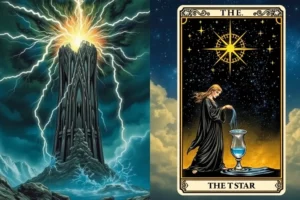
- Contrasting Forces: Opposing cards, like The Tower and The Sun, highlight tension and resolution. The Tower’s disruption may be followed by The Sun’s clarity, suggesting that breakdowns often precede breakthroughs.
- Hierarchical Influence: The order in which cards are drawn matters. A card drawn first often represents the foundation or the querent’s current state, while the second card may indicate a challenge, opportunity, or outcome. For instance, Three of Cups followed by Five of Pentacles could reflect joy turning into hardship, or the need to find community in difficult times.
- Elemental Dialogues: Each suit corresponds to an element—Wands (Fire), Cups (Water), Swords (Air), and Pentacles (Earth). When cards from different suits appear, their elemental interplay adds depth. A fiery Wands card with a watery Cups card might suggest passion tempered by emotion, or a need to balance action with feeling.
To master this language, practice with simple two-card spreads. Draw a card, note its core message, then draw a second and observe how it shifts the first card’s meaning. Over time, you’ll develop an intuitive sense of how cards converse, much like learning to read between the lines of a conversation.

Narrative Arcs: Crafting Stories from Card Combinations
Every tarot spread is a story waiting to be told. When reading multiple cards, think of them as chapters in a book, each contributing to the plot. A three-card spread, for example, might represent past, present, and future—but it could also symbolize situation, action, and outcome, or mind, body, and spirit. The structure is flexible; what matters is the narrative you create.
Consider a spread with The Empress, Eight of Swords, and The Chariot. The Empress could represent abundance and nurturing, the Eight of Swords might show feeling trapped, and The Chariot suggests determination to overcome obstacles. Together, they tell a story of potential stifled by self-imposed limitations, followed by the drive to break free. The narrative isn’t just about the cards—it’s about the journey they imply.
To deepen your storytelling, ask questions like: What is the central conflict? Who are the key players? What is the turning point? The more you engage with the cards as a narrative, the more vivid and personal the reading becomes. This approach is especially powerful for clarifying complex situations, as it breaks down overwhelming issues into digestible parts.
The Art of Interpretation: Balancing Structure and Intuition
While structure provides a framework, intuition is the heart of tarot reading. Combining the two creates a balanced approach that honors both tradition and personal insight. Start by grounding yourself in traditional meanings—learn the core symbols, numerology, and elemental associations of each card. This knowledge acts as a foundation, much like grammar in a language.
Then, let your intuition guide you. Notice the images that stand out, the emotions they evoke, or the unexpected connections that arise. For example, if you draw The Hierophant and Judgement, traditional meanings might emphasize tradition and awakening. But if you feel drawn to the contrast between the Hierophant’s rigid structure and Judgement’s call for transformation, your intuition might highlight a need to question outdated beliefs before embracing change.
Remember, there are no wrong interpretations—only less resonant ones. The goal is to find meaning that resonates with the querent (and yourself, if you’re reading for yourself). Trust your gut, but also be open to refining your understanding as you gain experience.
Common Pitfalls and How to Avoid Them
Even seasoned readers can fall into traps when interpreting multiple cards. Here are a few to watch for:
- Overcomplicating the Spread: It’s easy to see too much in a combination. Stick to the most prominent themes unless deeper layers reveal themselves naturally. If a spread feels cluttered, simplify it by focusing on the core message of each card.
- Ignoring Reversals: Reversed cards add nuance, but they’re not always necessary. If a card feels off, consider whether it’s reversed or simply interacting with another card in a way that alters its energy. For example, a reversed Ten of Cups might not indicate disharmony but rather a need to redefine what happiness means.
- Forcing Connections: Not every card in a spread will have a direct relationship. Some may represent background elements or external influences. Avoid forcing a narrative where none exists—sometimes, the message is simply that the situation is complex.
- Neglecting the Querent’s Context: Tarot is a tool, not a crystal ball. Always consider the querent’s life, questions, and emotions. A spread that makes perfect sense in theory might not align with their reality. Ask open-ended questions to clarify their perspective.
Practical Exercises to Hone Your Skills
Like any language, tarot reading improves with practice. Try these exercises to sharpen your ability to interpret card combinations:
- Daily Two-Card Draw: Each morning, draw two cards and journal about their interaction. How do they complement or challenge each other? What story do they tell?
- Elemental Pairings: Focus on cards from different suits and explore their elemental relationships. How does Fire (Wands) interact with Water (Cups)? What insights emerge from their clash or harmony?
- Card as Character: Pick a card and imagine it as a person in a story. How would it behave? What role would it play if it were a character in a novel or film? Then, draw a second card and explore their dynamic.
- Reverse Engineering: Take a well-known tarot spread (like the Celtic Cross) and reverse-engineer it. Draw the cards first, then create a narrative that fits the positions. Compare your story to traditional interpretations.
- Synchronicity Journal: Keep a record of meaningful card combinations you encounter in readings, media, or even dreams. Over time, you’ll notice patterns and themes that deepen your understanding.
Conclusion: Embracing the Magic of Multiple Cards
Reading multiple tarot cards together is like conducting an orchestra—each card is an instrument, and your interpretation is the conductor’s baton, guiding the symphony to life. It’s a practice that transforms chaos into clarity, confusion into insight, and randomness into meaning. By learning to see cards as interconnected voices rather than isolated symbols, you unlock a deeper layer of the tarot’s wisdom.
Remember, there’s no single “correct” way to read combinations. The magic lies in the dialogue you create between the cards and your own intuition. Whether you’re seeking guidance for a specific question or simply exploring the tarot’s depths, embrace the process with curiosity and an open heart. The more you practice, the more the cards will reveal—not just about the future, but about the intricate, beautiful chaos of life itself.
FAQ
What does it mean to read multiple tarot cards together?
Reading multiple tarot cards together means interpreting the cards as parts of a connected story or message to gain deeper insight than from individual cards.
How do elemental suits affect tarot card combinations?
Elemental suits add meaning by showing interactions like harmony or tension between passion (Fire), emotion (Water), intellect (Air), and material concerns (Earth).
What are common mistakes when reading multiple tarot cards?
Mistakes include overcomplicating interpretations, ignoring reversed cards, forcing connections between unrelated cards, and ignoring the querent's context.
How can beginners improve their tarot card combination reading skills?
Practice daily two-card draws, explore elemental pairings, and imagine cards as characters to develop understanding and intuition.
Leave a Reply