Short Answer
The Death card in tarot, often met with trepidation, serves as a powerful symbol ripe with meaning and interpretation. Within a Christian framework, this card transcends its grim nomenclature and invites an exploration of themes like transformation, renewal, and divine providence. It evokes the duality of life and death, reflecting a deeper understanding of existence through the lens of faith.
In tarot, the Death card is often mistakenly perceived as a negative omen, invoking fear of mortality and the end of life’s journey. Yet, a Christian perspective reframes this interpretation, guiding adherents towards a more profound comprehension of both spiritual and existential metamorphosis. Just as the Apostle Paul elucidates in Corinthians, the notion of dying to oneself and being reborn in Christ exemplifies the paradox inherent in the Death card.
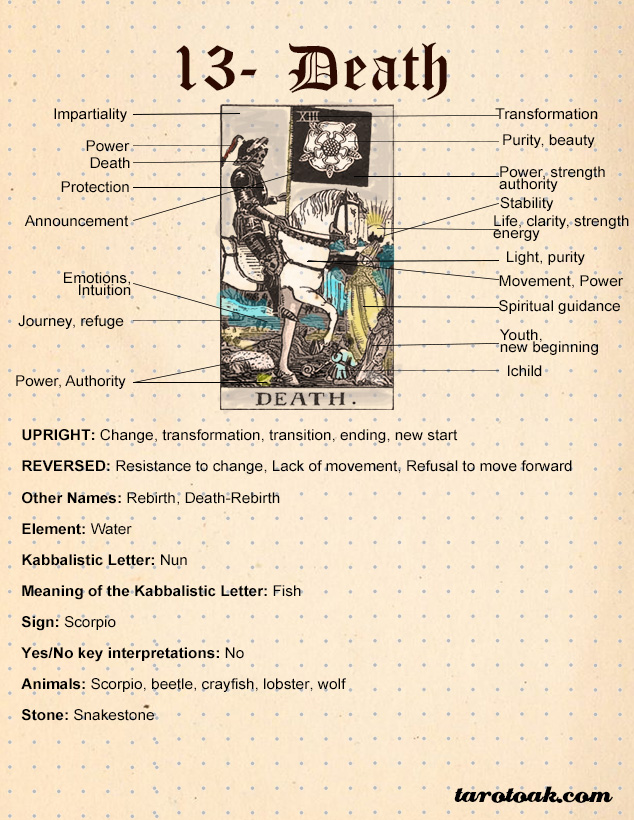
The imagery associated with the Death card—often featuring a skeletal figure brandishing a scythe—evokes a visceral response. However, we must dissect this visual metaphor. The scythe, while traditionally a harbinger of death, also represents the reaping of life’s harvest. It parallels the Christian belief in resurrection and renewal. Just as a farmer gathers ripe wheat, so too does the spirit transition from one realm to another, allowing for renewal and fresh beginnings. This evokes the biblical metaphor of the seed; unless it dies, it cannot bear fruit, illustrating the cycle of death and rebirth that is fundamental to Christian theology.
Moreover, the Death card embodies the essential Christian tenet of surrender—relinquishing the old to embrace the new. This notion is epitomized in the New Testament, where followers are called to crucify their old selves in favor of a new life in Christ. Embracing this transformative aspect of the Death card encourages believers to reflect on the areas of their lives that require relinquishment or transformation. It exhorts one to confront old habits, relationships, or beliefs that no longer bear fruit, advocating for a purging process that invites divine renewal.
At a pivotal juncture, the Death card also resonates with the theme of judgment—a prominent aspect of Christian eschatology. In Christian belief, the end times herald a reckoning where souls are weighed, illuminating the duality of life and eternal destiny. Hence, the skeletal figure of the Death card may represent the call to introspection and moral rectitude while reminding believers to adhere to the teachings of Christ, who emphasized love, grace, and redemption. This encourages individuals to live purposefully, fostering an understanding that each day is an opportunity to align oneself closer to divine principles.
While the Death card does allude to the physical end, its primary focus is on the cyclical nature of existence. Christians are reminded through scripture that death is not an end but a passage—a necessary transition rather than a finality. The Gospel of John poignantly speaks of eternal life through faith, thus, good news resonates within the contemplative depths of the Death card. It ignites hope, assuring the believer that earthly demise leads to heavenly embrace. This concept shines a light on the often-misunderstood premise of death, urging one to view it not as loss but as the ultimate gain.
Furthermore, the symbolism of endings achieved through the Death card invites reflection on personal and spiritual paths. It calls on individuals to assess their own trajectory within life’s circle. In Christianity, this mirrors the concept of carrying one’s cross—a willingness to endure trials and surrender to God’s plan. This emblematic journey of suffering, akin to the path taken by Christ, presents a transformative experience. The Death card, therefore, beckons individuals to confront their fears, much as Peter confronted his fears on the water. It empowers believers to tread into the unknown with faith, anchoring the spirit in a world that thrives on change and impermanence.
Ultimately, the Death card espouses the principle of hope, a cornerstone of the Christian faith. It is an embodiment of life’s cyclical nature and the constant state of evolution that pervades human existence. The celebration of Easter, reminiscent of Christ’s resurrection, underscores the essence of rejuvenation and triumph over death itself. This theological perspective grounds the Death card not in despair but in joyous anticipation of what lies ahead.
To distill the essence of the Death card through the lens of Christianity is to embrace a dance with life’s dualities. It invites reflection on mortality while simultaneously offering a palette of infinite possibilities. Transformation, renewal, judgment, and ultimately hope characterize the core essence of the message contained within this card. Far from a harbinger of doom, the Death card crafts a narrative rich with the promise of new horizons, urging believers to welcome change, seek divine purpose, and cultivate a deeper faith in the life that follows. The Death card is not merely a symbol; it is a profound invitation to embrace the sacred journey of existence, allowing faith to illuminate the paths once shrouded in darkness.
FAQ
What does the Death card represent in tarot?
The Death card symbolizes transformation, renewal, and the cyclical nature of life, rather than a literal end.
How is the Death card interpreted in a Christian context?
In a Christian context, the Death card emphasizes surrender, rebirth, and the hope of eternal life.
What imagery is associated with the Death card?
The Death card typically features a skeletal figure with a scythe, symbolizing the reaping of life’s harvest and the transition from one realm to another.
Leave a Reply