Short Answer
Welcome to your comprehensive guide on Moon Cards (All Angles – For Children). In this article, you’ll explore the fascinating world of moon phase cards designed specifically for young learners. These educational tools help children understand the lunar cycle, enhance vocabulary, and develop cognitive skills through engaging visuals and interactive activities. Whether you’re a parent, educator, or caregiver, this guide will provide insights into the different types of moon cards available, their benefits, and how to use them effectively to foster a love for astronomy in kids.
Understanding Moon Cards and Their Purpose
Moon cards are educational resources that visually represent the different phases of the moon. These cards are typically used to teach children about the lunar cycle, which includes the new moon, waxing crescent, first quarter, waxing gibbous, full moon, waning gibbous, last quarter, and waning crescent. By using moon cards, children can learn to identify each phase, understand the sequence of the cycle, and grasp the scientific concepts behind the moon’s appearance changes.
These cards often come in various formats, such as flashcards, matching games, or nomenclature cards, each serving a unique purpose in early childhood education. For instance, flashcards may include images of the moon phases along with their names, while matching games encourage children to pair the correct phase with its name or description. Nomenclature cards, on the other hand, provide a more structured approach by labeling each phase with both the name and a brief explanation, making them ideal for Montessori-style learning.
Types of Moon Cards for Children
There are several types of moon cards designed to cater to different learning styles and age groups. Below are some of the most common types you’ll encounter:
Flashcards
Flashcards are one of the most popular types of moon cards. They typically feature an image of a specific moon phase on one side and the name or description on the other. These cards are perfect for quick review sessions, quizzes, or memory games. For example, a flashcard might show a waxing crescent moon on one side and the text “Waxing Crescent: A sliver of the moon is visible on the right side” on the reverse. Flashcards are versatile and can be used individually or in groups, making them a staple in both classroom and home learning environments.
Matching Games
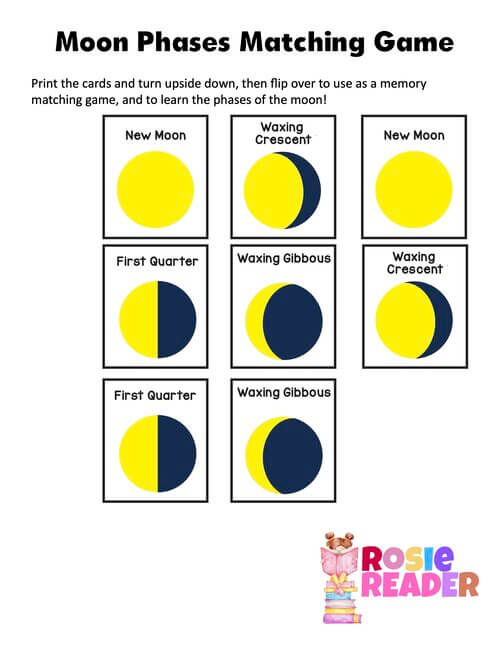
Matching games are another excellent type of moon card that encourages active learning. These games usually consist of pairs of cards: one card with an image of a moon phase and another with the corresponding name or description. Children must match the image to the correct label, reinforcing their understanding of the lunar cycle. Matching games are particularly effective for visual learners and can be played solo or in groups, promoting both independent and collaborative learning.
Nomenclature Cards
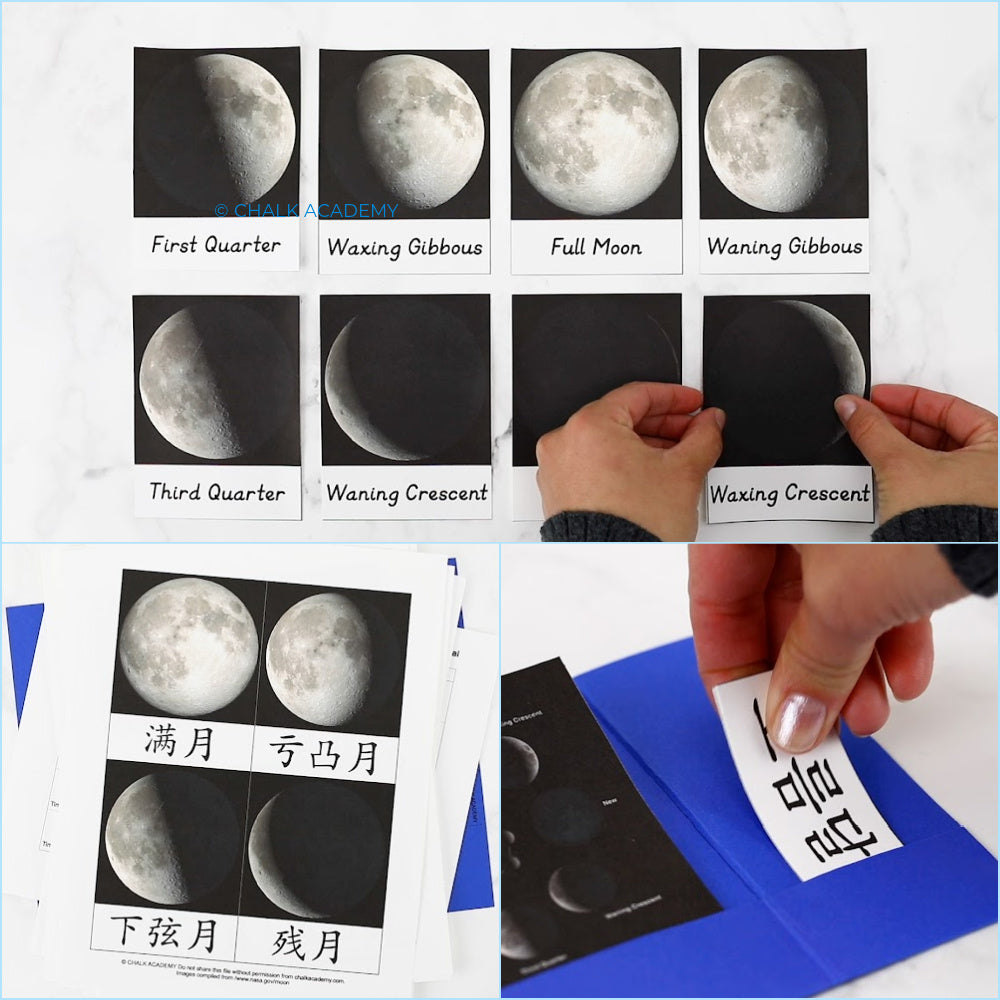
Nomenclature cards are a staple in Montessori education and are designed to teach children the precise terminology associated with moon phases. These cards typically include three parts: a picture of the moon phase, a label with the name, and a control card that combines both the image and the label. Children use these cards to match the image to the label, and later, they can use the control card to check their work. Nomenclature cards are ideal for hands-on learners and help build vocabulary and reading skills while teaching scientific concepts.
Interactive Posters and Charts
Interactive posters and charts are larger visual aids that display the entire lunar cycle in a single image. These can be hung on walls or used as tabletop references during lessons. Some posters include movable pieces, such as arrows or labels, that children can manipulate to identify different phases. Interactive posters are great for group discussions and can serve as a constant visual reminder of the moon’s cycle in a learning space.
Benefits of Using Moon Cards for Children
Incorporating moon cards into a child’s learning routine offers numerous benefits that extend beyond simply teaching the phases of the moon. Here are some key advantages:
Enhances Scientific Literacy
Moon cards introduce children to basic astronomical concepts, helping them develop a foundational understanding of the solar system and the moon’s role within it. By learning about the lunar cycle, children gain insights into how celestial bodies move and interact, fostering an early interest in science and space exploration.
Develops Cognitive Skills
Using moon cards encourages critical thinking, memory, and problem-solving skills. For example, matching games require children to recall and associate images with their corresponding labels, while flashcards can be used for quick recall exercises. These activities stimulate cognitive development and improve retention of information.
Supports Language and Vocabulary Growth
Moon cards often include terminology specific to astronomy, such as “waxing,” “waning,” “gibbous,” and “crescent.” By repeatedly encountering and using these terms, children expand their vocabulary and improve their language skills. Nomenclature cards, in particular, are excellent for teaching precise terminology in a structured way.
Encourages Hands-On Learning
Many moon cards are designed for tactile engagement, allowing children to physically interact with the material. Whether they’re matching cards, labeling images, or arranging phases in order, these hands-on activities make learning more dynamic and memorable. This approach is especially beneficial for kinesthetic learners who thrive when they can touch and manipulate objects.
Promotes Independent Learning
Moon cards can be used by children independently, allowing them to explore and review the material at their own pace. This fosters a sense of autonomy and self-directed learning, which are valuable skills for lifelong education. Parents and educators can set up learning stations with moon cards, encouraging children to engage with the material without constant guidance.
How to Use Moon Cards Effectively
To maximize the educational value of moon cards, it’s important to use them in ways that align with a child’s developmental stage and learning style. Here are some strategies to consider:
Start with the Basics
Begin by introducing the eight primary phases of the moon using simple, clear images. Use flashcards or a poster to show the sequence of the lunar cycle, and explain each phase in age-appropriate language. For younger children, focus on the visual differences between the phases, such as the shape and position of the illuminated portion of the moon.
Incorporate Storytelling
Turn the learning process into a story to make it more engaging. For example, you might describe the moon as a character that changes its appearance each night, growing from a tiny sliver to a full circle and then shrinking back again. Storytelling helps children remember the sequence of the phases and adds a creative element to the lesson.
Use Games and Activities
Games are a fantastic way to reinforce learning. Try activities like “Moon Phase Bingo,” where children mark off phases as they’re called out, or “Moon Phase Charades,” where they act out a phase for others to guess. You can also create a DIY moon phase wheel, where children spin a dial to land on a specific phase and then describe it. These games make learning fun and interactive.
Combine with Other Learning Tools
Moon cards can be used alongside other educational resources to create a well-rounded learning experience. For example, pair them with books about the moon, videos explaining the lunar cycle, or even a telescope for nighttime observation. Combining multiple tools helps children make connections between different types of information and deepens their understanding.
Encourage Observation and Discussion
Encourage children to observe the moon in the night sky and compare their observations to the moon cards. Ask questions like, “What phase do you think the moon is in tonight?” or “How does the moon look different from yesterday?” Discussing their observations helps them apply what they’ve learned and develop a habit of scientific inquiry.
Conclusion
Moon cards are a versatile and effective tool for teaching children about the lunar cycle and fostering a love for astronomy. Whether you’re using flashcards, matching games, nomenclature cards, or interactive posters, these resources provide a hands-on, engaging way to explore the wonders of the moon. By incorporating moon cards into your teaching routine, you can enhance scientific literacy, develop cognitive and language skills, and encourage independent learning. With the right approach, moon cards can transform a simple lesson about the moon into an exciting adventure that sparks curiosity and a lifelong passion for science.
FAQ
What are moon cards?
Moon cards are educational tools that visually represent the different phases of the moon, designed to help children learn about the lunar cycle.
How can moon cards benefit children?
Moon cards enhance scientific literacy, develop cognitive skills, support language growth, encourage hands-on learning, and promote independent learning.
What types of moon cards are available?
Common types of moon cards include flashcards, matching games, nomenclature cards, and interactive posters.
Leave a Reply