Short Answer
Welcome to a journey into the heart of the divine paradox—where creation and destruction dance in an eternal embrace. In this guide, you’ll explore the multifaceted essence of The Empress Kali, a goddess whose presence is as terrifying as it is transformative. You’ll discover her origins, symbolism, and the ways she challenges devotees to confront their shadows. By the end, you may find yourself asking: Can you truly embrace the darkness without losing yourself in it? And perhaps, more importantly, what would it take to stand in her fire and emerge renewed?
The Many Faces of Kali: Beyond the Stereotypes
Kali is often depicted with a garland of skulls, a sword in one hand, and a severed head in another—images that evoke fear and awe in equal measure. Yet, these representations are not merely symbols of destruction; they are invitations to transcend the illusory boundaries of fear. Kali’s dark skin, a stark contrast to the luminous deities of the Hindu pantheon, symbolizes the void from which all creation emerges. She is the night that precedes the dawn, the silence before the chant, the stillness that births movement.

Her most famous form, Kali Ma (“Mother Kali”), embodies the nurturing aspect of the divine feminine. She is the protector of the innocent, the slayer of demons, and the embodiment of time itself. Yet, she is also Bhadrakali, the gentle and benevolent form, and Mahakali, the supreme cosmic force that dissolves all dualities. To understand Kali is to accept that destruction is not the opposite of creation but its necessary counterpart—a truth that challenges the linear thinking of modern spirituality.
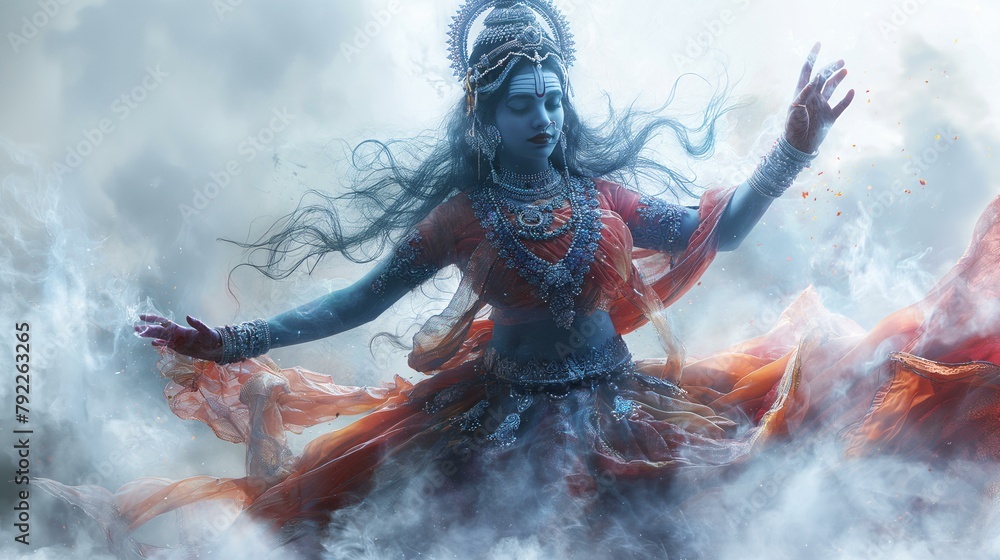
Symbolism and Iconography: Decoding Kali’s Tools
Every element in Kali’s iconography carries profound meaning. Her black or dark blue skin represents the infinite, the formless, and the unmanifest. It is the color of the womb and the grave, the beginning and the end. Her four arms signify the four directions, the four stages of life, and the four Vedas—symbolizing her omnipresence and omnipotence.
Her sword (khadga) is the blade of discernment, cutting through ignorance and ego. The severed head she holds represents the ego’s surrender, the death of the false self that clings to material attachments. The garland of skulls (mundamala) is a reminder of the impermanence of life and the cyclical nature of existence. Even her tongue sticking out is not a sign of shame but a gesture of triumph—consuming the ego and the demons of ignorance.
Her dance (Tandava) on the prone body of her consort, Shiva, illustrates the dynamic interplay of creation and destruction. Shiva, the stillness, lies beneath her feet, symbolizing that even the most profound stillness is subject to the divine dance. This imagery teaches that destruction is not an end but a transformation—a necessary step toward renewal.

The Dual Nature: Kali as Creator and Destroyer
Kali’s duality is not a contradiction but a reflection of the universe’s inherent balance. She is the womb of the cosmos, giving birth to galaxies, stars, and souls, and she is the consuming fire that reduces all forms to their essence. This duality is echoed in the Hindu concept of Lila—the divine play—where creation and destruction are not opposing forces but complementary aspects of the same reality.
In the Devi Mahatmya, a sacred text, Kali emerges from the forehead of the goddess Durga to slay the demon Raktabija. Her battle is not one of violence but of purification. Each drop of the demon’s blood that falls to the ground spawns another demon, forcing Kali to drink it all—symbolizing the absorption of negativity and the prevention of its proliferation. This story teaches that true strength lies not in external conquest but in the ability to integrate and transcend the shadows within.
For devotees, Kali’s dual nature is a call to embrace both the light and dark within themselves. She challenges us to ask: Where do we draw the line between protection and destruction? And more importantly, are we willing to face the parts of ourselves we fear the most?
Rituals and Worship: How to Invoke Kali’s Energy
Worshipping Kali is not for the faint of heart. Her rituals are intense, often involving fire, blood offerings (traditionally symbolic, such as red flowers or red cloth), and mantras that resonate with her fierce energy. The most common mantra associated with Kali is the Kali Beej Mantra:
Om Kreem Kalikayai Namah
This mantra invokes Kali’s transformative power, helping devotees dissolve their ego and embrace their inner strength. Chanting it with devotion is said to awaken the dormant Kundalini energy, leading to spiritual awakening.
Offerings to Kali often include red flowers (such as hibiscus or roses), sandalwood paste, cooked rice, and sweets made with jaggery. The color red is sacred to her, symbolizing both her fierce nature and the life force (Shakti) that flows through all existence. Some traditions also include meat and alcohol as offerings, reflecting the Tantric principle of transcending dualities by embracing all aspects of life, even those deemed impure.
Meditation on Kali often involves visualizing her standing on Shiva, her tongue outstretched, and her eyes blazing with the fire of destruction. Devotees may also meditate on her as the void—the space between thoughts—where all dualities dissolve. This practice is not for the passive observer but for the seeker willing to confront the abyss and emerge transformed.

The Shadow Work Challenge: Can You Stand in Kali’s Fire?
Kali’s energy is not for passive worship—it demands action. She is the goddess of shadow work, the process of confronting and integrating the repressed aspects of the self. This could mean facing past traumas, acknowledging repressed anger, or even embracing the parts of yourself you’ve been taught to hide. The challenge she presents is simple yet daunting: Are you willing to burn away the illusions that bind you?
Start by asking yourself:
- What fears or insecurities have I been avoiding?
- Where in my life am I clinging to what no longer serves me?
- Am I willing to let go of my ego’s need for control?
Journaling, meditation, and even confronting difficult relationships can be forms of Kali’s fire. Remember, she does not destroy for the sake of destruction—she destroys to make way for rebirth. The question is not whether you can survive the fire, but whether you can transform within it.
Conclusion: Embracing the Divine Paradox
The Empress Kali is not a goddess to be worshipped from a distance. She is a force to be reckoned with—a mirror that reflects the raw, unfiltered truth of existence. She teaches that creation and destruction are not separate but intertwined, that darkness is not the absence of light but its necessary counterpart. To stand in her presence is to stand at the threshold of the unknown, where fear and awe coexist.
So, the final question remains: Will you answer her call? Will you step into the fire, not as a victim of destruction, but as a phoenix rising from its ashes? Kali does not offer easy answers or gentle paths. She offers the truth—and the truth, though liberating, is not always comfortable. But in that discomfort lies the potential for the most profound transformation of all.
Embrace the darkness. Dance with the void. And when you emerge, you may find that you were never separate from her in the first place.
FAQ
What is the significance of Kali in Hinduism?
Kali represents the transformative aspects of creation and destruction, embodying both the nurturing and fierce elements of the divine feminine.
How can one invoke Kali's energy?
Kali’s energy can be invoked through rituals involving intense devotion, offerings, and the chanting of her mantras, such as the Kali Beej Mantra.
What does shadow work involve in the context of Kali?
Shadow work involves confronting and integrating repressed aspects of the self, guided by Kali’s fierce energy, to achieve personal transformation.
Leave a Reply