Short Answer
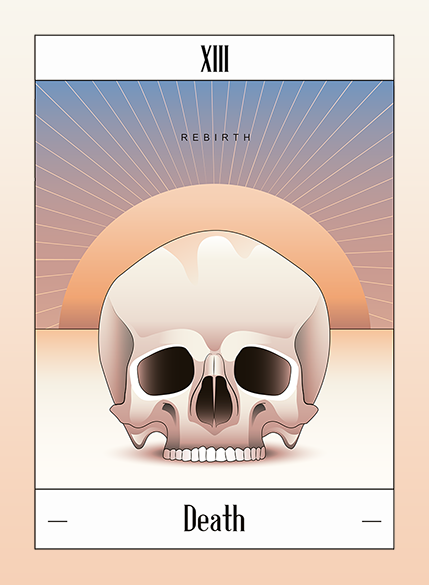
The Death card, prominently known as the 13th card of the Major Arcana in the Tarot deck, often elicits visceral reactions among readers and seekers alike. For many, especially within a Christian context, its symbolism can invoke apprehension, dread, or even revulsion. This multifaceted card, however, transcends mere mortality and offers layers of meaning that resonate deeply, serving not only as a harbinger of the end but as a profound reminder of the cyclical nature of existence.
To comprehend the Death card’s implication, one must first delve into its iconic imagery. Traditionally depicted as a skeletal figure clad in black armor, often riding a pale horse, the visual representation can evoke the grim reaper archetype. This imagery conjures a sense of finality—one that aligns closely with the Christian perspective on death. Within Christianity, death is frequently viewed as the ultimate transition, momentously marking a passage from earthly existence to eternal life. Thus, while many perceive the card through a lens of doom, it also synchronizes with the Christian ethos of resurrection and hope.
The Death card signifies several concepts, the most prominent being transformation and renewal. In the Bible, life is often portrayed as a series of transformative experiences that reshape one’s spirit. For Christians, the narrative of death is intricately woven with rebirth—as seen in the resurrection of Christ, which underscores the idea that endings pave the way for new beginnings. This theological underpinning allows for a synergistic interpretation of the Death card: it is not merely about physical demise, but rather a harbinger of spiritual evolution and personal metamorphosis.
This notion of transformation invites contemplation on the human experience. The Death card can signify the end of a significant stage, relationship, or phase in one’s life, compelling individuals to confront their own mortality and the impermanence of existence. Reflecting on Christian teachings, one recognizes that trials and tribulations serve as catalysts for spiritual growth. It echoes the sentiment found in Romans 5:3-4, which states, “Not only that, but we rejoice in our sufferings, knowing that suffering produces endurance, and endurance produces character, and character produces hope.” The trials symbolized by the Death card align with the Christian principle of using adversity as a crucible for spiritual refinement.
Moreover, the Death card challenges us to examine our attachments and the transient nature of worldly possessions and relationships. In a Christian framework, this invites reflection upon the teachings of Jesus regarding the riches of the kingdom of heaven versus earthly wealth. As articulated in Matthew 6:19-21, “Do not lay up for yourselves treasures on earth, where moth and rust destroy and where thieves break in and steal, but lay up for yourselves treasures in heaven.” The shedding symbolized by the Death card can represent the need to relinquish attachments that do not serve one’s spiritual journey, urging believers to focus on cultivating everlasting spiritual wealth.
The card’s symbolism can also invite introspection on the inevitability of death itself. Unlike many pagan or esoteric interpretations which may suggest a cyclical rebirth, Christianity presents death as a definitive conclusion to earthly life before eternal judgment. This dichotomy of perspectives can create a fascinating dialogue between Tarot readings and biblical teachings. The recognition that mortality is an inescapable reality can instill a sense of urgency to live a life steeped in purpose, fidelity, and faith. In that regard, the Death card serves as a contemplative mirror, reflecting the need to embrace life fully, aware of the temporal constraints it imposes.
Furthermore, the Death card can signify the end of conflict or tumultuous relationships. Within a Christian worldview, this card holds a message of forgiveness and closure. Just as Christ forgives human transgressions, the Death card encourages individuals to release past grievances and forgive, creating space for healing and rejuvenation. It highlights the importance of resolution and peace, allowing the liberated spirit to move forward unencumbered by the weight of resentment and bitterness.
In the realm of Tarot, another perspective on the Death card revolves around its association with the concept of destiny. Predominantly within Christian eschatology, the idea of divine providence indicates that while life may present unforeseen challenges or endpoints, it is ultimately directed by a higher power toward a greater purpose. The Death card serves as a reminder to trust in the divine plan, acknowledging that every ending is a celestial orchestration leading to an inevitable fulfillment of God’s will.
In conclusion, the Death card’s meaning within Tarot envelops a complex array of themes that resonate deeply in a Christian context. While it may initially provoke anxiety or fear, its deeper significance is rooted in transformation, renewal, hope, and the intrinsic value of letting go. The card prompts individuals to embrace spiritual evolution, seek closure, and renew their faith in the divine journey ahead. Ultimately, the Death card invites seekers to look beyond its foreboding imagery, encouraging a reflective embrace of life’s cyclical nature, enriched by the profound promise of eternal life through faith.
FAQ
What does the Death card signify in Tarot?
The Death card signifies transformation, renewal, and the cyclical nature of existence rather than just physical death.
How is the Death card interpreted in a Christian context?
In a Christian context, the Death card represents a transition towards spiritual evolution and the hope of resurrection.

Leave a Reply