Short Answer
Welcome to a deep exploration of the Rider-Waite-Smith Tarot, a deck that has captivated minds for over a century. In this guide, you’ll uncover the visionary artistry of Pamela Colman Smith and the esoteric symbolism she wove into each card. You’ll also confront the darker, more chaotic interpretations of Aleister Crowley’s Thoth Tarot, which offers a starkly different lens through which to view the same archetypes. By comparing these two iconic decks, you’ll gain insight into how perspective shapes meaning—and perhaps even discover which resonates with your own spiritual or intuitive journey. Whether you’re a seasoned reader or a curious newcomer, prepare to have your understanding of tarot transformed.
The Birth of a Revolutionary Deck: Pamela Colman Smith’s Vision
The Rider-Waite-Smith Tarot, first published in 1909, emerged from a collaboration between artist Pamela Colman Smith and mystic A.E. Waite. Unlike earlier decks, which relied on traditional playing card imagery, Smith’s illustrations introduced a narrative depth that had never been seen before. Her work was deeply influenced by her studies in the Hermetic Order of the Golden Dawn, where she absorbed esoteric symbolism, occult philosophy, and the power of visual storytelling.
Smith’s approach was intuitive and collaborative. Waite provided the textual framework, but it was Smith who breathed life into the cards, infusing them with emotion, movement, and a sense of mystery. Her use of color, composition, and symbolic details—such as the inclusion of everyday objects like cups, swords, and coins—made the tarot accessible to a broader audience. This was not just a tool for divination; it was a mirror reflecting the human experience in all its complexity.

The Thoth Tarot: Crowley’s Nightmare of Esoteric Chaos
Where Smith’s deck is a tapestry of light and symbolism, Aleister Crowley’s Thoth Tarot, designed in the 1940s, is a storm of esoteric intensity. Crowley, a magician and occultist, sought to reinterpret the tarot through the lens of Thelema, his spiritual philosophy centered on the axiom “Do what thou wilt shall be the whole of the Law.” The result was a deck that was as much a manifesto as it was a divinatory tool.
Crowley’s collaboration with artist Lady Frieda Harris produced a deck that is visually dense, filled with alchemical symbols, astrological correspondences, and complex geometric patterns. The imagery is far less literal than Smith’s, often requiring deep study to unpack. For example, the Fool card in the Thoth deck is not a carefree wanderer but a figure suspended in a void, surrounded by swirling forces of creation and destruction. This reflects Crowley’s view of the tarot as a map of the soul’s journey through the abyss—a path fraught with peril and enlightenment.
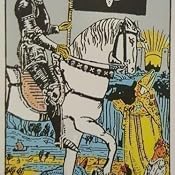
Key Differences: Perspective Shifts in Symbolism
The most striking difference between the two decks lies in their interpretation of the Major Arcana. In the Rider-Waite-Smith deck, cards like The High Priestess and The Empress are depicted with serene, almost maternal energy. The High Priestess, for instance, sits between two pillars, her scroll half-hidden, symbolizing hidden knowledge and intuition. In contrast, Crowley’s High Priestess (or “The High Priestess II”) is a more dynamic figure, surrounded by lunar symbols and a crescent moon, embodying the duality of light and shadow.
Another example is The Tower. In the Rider-Waite-Smith version, the card shows a tall tower struck by lightning, with two figures falling from its heights—a dramatic but contained scene. Crowley’s Tower, however, is a swirling vortex of chaos, with a lightning bolt that seems to tear through the fabric of reality itself. This reflects Crowley’s belief in the destructive power of enlightenment, where the ego must be shattered to make way for true understanding.
The Minor Arcana also diverges significantly. Smith’s deck uses everyday scenes to illustrate the suits of Cups, Swords, Wands, and Pentacles, making the cards relatable to modern life. Crowley’s Minor Arcana, however, is steeped in astrological and alchemical symbolism. The suit of Wands, for example, is associated with the element of fire and the zodiac signs Aries, Leo, and Sagittarius, adding layers of meaning that require study to fully grasp.
Which Deck Resonates? The Power of Personal Interpretation
The choice between the Rider-Waite-Smith and Thoth decks ultimately comes down to personal resonance. If you are drawn to a deck that feels intuitive, emotionally evocative, and visually accessible, the Rider-Waite-Smith may be your guide. Its imagery is designed to speak to the subconscious, making it ideal for beginners and those who prefer a more narrative approach to divination.
On the other hand, if you are intrigued by the occult, symbolism, and a more cerebral approach to tarot, Crowley’s Thoth deck may call to you. Its complexity invites deep study and reflection, appealing to those who see tarot as a tool for spiritual evolution rather than mere fortune-telling. Both decks offer profound insights, but they do so through vastly different lenses.

Conclusion: A Shift in Perspective
The Rider-Waite-Smith and Thoth Tarot decks are not just tools for divination; they are gateways to different ways of seeing the world. Pamela Colman Smith’s vision offers a path of gentle revelation, where symbols and emotions guide the reader toward self-discovery. Aleister Crowley’s Thoth, meanwhile, presents a more challenging journey, one that demands courage and a willingness to confront the darker aspects of the human psyche.
Whether you choose one or both, these decks invite you to explore the depths of your own consciousness. They remind us that perspective is everything—that the same archetypes can inspire peace or chaos, clarity or confusion, depending on the lens through which we view them. As you delve into their imagery, let curiosity be your guide. The tarot is not just a mirror; it is a conversation between the seen and the unseen, the known and the unknown. And in that conversation, you may find the answers you seek—or the questions you never knew to ask.
FAQ
What is the difference between the Rider-Waite-Smith Tarot and the Thoth Tarot?
The Rider-Waite-Smith Tarot is known for its intuitive and emotionally accessible imagery, while the Thoth Tarot offers a complex approach filled with esoteric symbolism and philosophical undertones.
Which tarot deck is better for beginners?
The Rider-Waite-Smith Tarot is often recommended for beginners due to its relatable imagery and narrative depth.
How do the Major Arcana differ in these decks?
The Major Arcana in the Rider-Waite-Smith deck typically portrays serene and maternal figures, while the Thoth deck presents more dynamic and chaotic representations.
Leave a Reply