Short Answer
Welcome to a deep exploration of the Five of Swords, a tarot card that embodies the raw energy of conflict, victory at a cost, and the lingering shadows of resentment. In this guide, you’ll uncover the intricate layers of this card’s meaning, from its historical roots to its modern interpretations. Whether you’re a seasoned tarot reader or a curious beginner, you’ll discover how the Five of Swords challenges us to confront the complexities of human nature—where triumph often comes with a bitter aftertaste. By the end, you’ll understand not just what this card represents, but how to harness its lessons in your own life.
The Five of Swords: A Card of Victory and Loss
The Five of Swords is a card that thrives in the tension between success and sacrifice. At its core, it depicts a scene of conflict—often a battlefield where one figure stands victorious, holding three swords, while two others walk away in defeat, their heads bowed. The imagery is stark: the victor’s stance is triumphant, but their expression is hollow, as if the price of winning was too steep. This duality is the card’s defining feature—it’s not just about winning, but about the emotional and psychological toll that victory can exact.
Metaphorically, the Five of Swords represents situations where you’ve “won the battle but lost the war.” It could be a workplace rivalry where you outmaneuvered a colleague, only to find yourself isolated; a personal dispute where you “proved your point” but damaged a relationship; or even an internal struggle where you compromised your values for short-term gain. The card asks you to reflect: Was the victory worth the cost?
In readings, the Five of Swords often appears when you’re grappling with the aftermath of a conflict. It’s a reminder that not all victories are clean or satisfying. Sometimes, the real lesson lies in recognizing when to walk away from a fight—or when to reconsider what “winning” truly means.
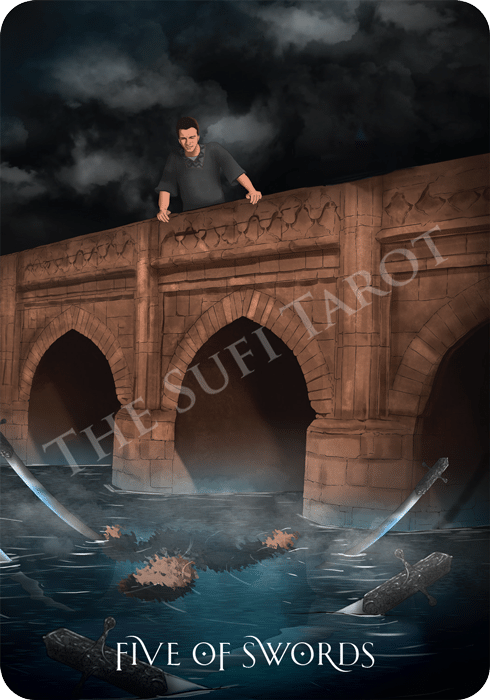
The Shadow Side: Resentment, Regret, and Isolation
Beneath the surface of victory lies the Five of Swords’ shadow—the emotions it leaves in its wake. Resentment, regret, and isolation are its hallmarks. The card’s imagery suggests a hollow triumph: the victor may have the upper hand, but they’re left standing alone, surrounded by the discarded swords of their opponents. This loneliness is a key theme. Winning at the expense of others often comes with a price: the loss of trust, camaraderie, or mutual respect.
Resentment is another critical aspect. The defeated figures in the card’s illustration don’t just walk away—they carry the weight of their loss, which can fester into bitterness over time. If you’ve ever held onto grudges after a conflict, the Five of Swords is a mirror reflecting that energy. It challenges you to ask: Are you holding onto anger because it makes you feel powerful, or because it’s eating away at you?
Isolation is the final layer. The card’s victor may have “won,” but they’re often left without allies. This can manifest in real life as strained relationships, a reputation for being cutthroat, or even self-imposed exile from communities that once supported you. The Five of Swords warns against the illusion that dominance equals fulfillment. True strength, it suggests, lies in connection—not conquest.
Upright vs. Reversed: The Dual Faces of Conflict
The Five of Swords’ meaning shifts dramatically depending on its orientation in a spread. When upright, it’s a call to acknowledge the consequences of your actions. It might appear when you’re in the midst of a power struggle, urging you to pause and consider the long-term impact of your choices. Are you prioritizing short-term gains over lasting relationships? Are you so focused on “winning” that you’ve lost sight of what truly matters?
In the reversed position, the Five of Swords takes on a different tone. Here, it often signals the avoidance of conflict—or the refusal to acknowledge its aftermath. You might be burying resentment, ignoring the fallout of a past argument, or even sabotaging your own success out of fear. Reversed, the card can also indicate that you’re finally ready to let go of old grudges, to walk away from a toxic dynamic, or to redefine what “winning” means to you. It’s a card of release, of choosing peace over pride.
Whether upright or reversed, the Five of Swords serves as a reminder that conflict is rarely black and white. It’s a spectrum of emotions, choices, and consequences, and the card’s energy invites you to navigate it with awareness.
Metaphors and Symbolism: Decoding the Five of Swords
The Five of Swords is rich with symbolism, each element offering a clue to its deeper meaning. The three swords held by the victor represent the tangible “spoils” of victory—achievements, recognition, or material gains. But the discarded swords on the ground symbolize the intangible losses: trust, respect, and emotional well-being. The stormy sky in the background further emphasizes the turmoil beneath the surface, a visual metaphor for the inner conflict that often accompanies external battles.
Another intriguing metaphor is the act of walking away. The defeated figures in the card don’t fight back; they simply leave, carrying their swords with them. This could symbolize the choice to disengage from a toxic situation, to prioritize your peace over proving a point. It’s a powerful reminder that sometimes, the bravest thing you can do is walk away—not out of weakness, but out of wisdom.
The card’s colors also play a role. The victor’s red cloak suggests passion, intensity, and perhaps even aggression, while the muted tones of the defeated figures reflect resignation or defeat. These colors aren’t just aesthetic choices; they’re emotional cues, guiding you to explore the feelings beneath the conflict.
Practical Applications: Navigating the Five of Swords’ Energy
So how do you work with the Five of Swords’ energy in your life? The first step is awareness. If this card appears in a reading, take a moment to reflect on the conflicts you’re currently facing—or the ones you’ve recently navigated. Are you holding onto resentment? Have you prioritized victory over connection? The card’s lesson is clear: true strength isn’t about dominating others, but about knowing when to fight and when to let go.
In relationships, the Five of Swords can be a warning sign. It might indicate that you’re in a dynamic where competition has overshadowed collaboration. If you’re the “victor” in a situation, ask yourself if the cost was worth it. If you’re the one walking away, consider whether this is a healthy boundary or an avoidance of necessary confrontation. The card encourages you to seek balance—where you can stand your ground without tearing others down.
For personal growth, the Five of Swords invites you to examine your relationship with power. Do you equate success with dominance? Do you struggle to admit when you’re wrong? The card challenges you to redefine what victory means. Is it possible to achieve your goals without leaving a trail of broken relationships in your wake? The Five of Swords suggests that the most fulfilling victories are those that uplift others as much as they uplift you.
Conclusion: The Wisdom of the Five of Swords
The Five of Swords is a card that doesn’t shy away from the messy, complicated nature of human conflict. It’s a mirror held up to our desires for power, our fears of defeat, and the emotional fallout of our choices. But it’s also a card of profound wisdom—one that reminds us that victory without integrity is a hollow prize. Whether you’re facing a workplace rivalry, a personal dispute, or an internal struggle, the Five of Swords asks you to pause and consider the true cost of your actions.
Ultimately, the card’s energy is a call to evolve. It challenges you to move beyond the binary of win or lose, to recognize that the most meaningful victories are those that leave both you and others stronger. It’s a lesson in humility, in the power of letting go, and in the quiet strength of choosing peace over pride. So the next time the Five of Swords appears in your life—or in a reading—take a deep breath. Ask yourself: What am I really fighting for? And more importantly, what am I willing to sacrifice to win?
FAQ
What does the Five of Swords represent?
The Five of Swords represents the duality of victory and loss, highlighting the emotional toll of winning at a cost.
How should I interpret the Five of Swords in a reading?
Interpret the Five of Swords as a reminder to consider the consequences of your actions and the emotional aftermath of conflict.

Leave a Reply