Short Answer
The 3-card tarot spread is one of the most versatile and intuitive layouts in divination. Whether you’re a seasoned reader or a curious beginner, this simple yet profound spread offers clarity, insight, and a mirror to your inner world. In this guide, you’ll discover how to interpret the past, present, and future—or any other trio of themes—with depth and precision. You’ll learn how to weave the cards into a narrative that resonates with your life’s journey, uncovering hidden patterns and unexpected revelations. By the end, you’ll see why this spread is a timeless tool for self-discovery and decision-making.
The Power of Three: Why the 3-Card Spread Works
The number three holds a sacred place in symbolism across cultures—past, present, and future; mind, body, and spirit; creation, preservation, and destruction. In tarot, this triad becomes a living dialogue between forces that shape your reality. Unlike complex spreads that demand memorization, the 3-card layout is accessible yet profound. It acts as a snapshot of your current state, a compass for your next steps, and a whisper from the universe about what’s to come. The beauty lies in its flexibility: you can assign meanings like “Situation, Challenge, Outcome,” “Mind, Body, Spirit,” or “Root, Path, Destination” to tailor the reading to your question. This adaptability makes it a favorite among readers who seek both simplicity and depth.
Imagine the spread as a conversation between three voices—the first card speaks of what has shaped you, the second reveals the energy surrounding you now, and the third offers a glimpse into the potential path ahead. Each card is a chapter in a story, and together, they form a cohesive narrative that feels almost like fate unfolding. The 3-card spread doesn’t just predict the future; it illuminates the present, helping you recognize the threads of your life that are already in motion.
How to Structure Your 3-Card Spread
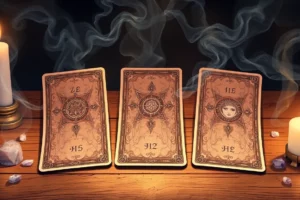
Before diving into interpretations, it’s essential to set the stage for your reading. Start by grounding yourself—light a candle, take deep breaths, or hold your deck close to your heart. Clarify your intention: Are you seeking guidance on a relationship, a career decision, or personal growth? The more specific your question, the more focused the reading will be. Once you’re centered, shuffle your deck while focusing on your query. When you feel ready, lay out three cards in a row from left to right.
There are countless ways to assign meanings to the positions, but here are three classic frameworks:
- Past, Present, Future: The most traditional layout, where the first card represents influences from your past, the second reflects your current situation, and the third hints at where things are headed.
- Situation, Challenge, Advice: Ideal for problem-solving, this spread breaks down a scenario into what’s happening, what obstacles you face, and what action you can take.
- Mind, Body, Spirit: A holistic approach that examines your mental, physical, and emotional well-being, offering balance and insight into areas needing attention.
Choose the structure that aligns with your question, or let intuition guide you. The cards will reveal themselves in their own time, and their positions will shape the story they tell.

Interpreting the Cards: A Dance of Symbols
Reading the 3-card spread is like deciphering a poetic riddle where each card is a verse. Begin with the first card—your past or foundation. Ask yourself: What lesson or experience from my history is influencing me now? For example, if you draw The Tower, it might indicate a past upheaval that reshaped your perspective. The second card, representing your present, is where the energy is most concentrated. Is it a Major Arcana card like The Empress, suggesting nurturing growth, or a Minor like the Eight of Cups, hinting at a journey of emotional withdrawal?
The third card is the wildcard—it could be a straightforward prediction or a call to action. If it’s The Star, it may signal hope and inspiration on the horizon. If it’s the Five of Swords, it could warn of conflict ahead, urging you to choose peace. Pay attention to the interplay between the cards: Do they flow harmoniously, or do they clash like stormy skies? The relationships between the cards—whether complementary, contrasting, or unresolved—add layers to your reading. For instance, pairing The Chariot (determination) with the Three of Pentacles (collaboration) might suggest a project where your drive meets teamwork.
Don’t forget to consider the suits and numbers. Cups often relate to emotions, Swords to intellect, Pentacles to material matters, and Wands to passion. Aces signify new beginnings, while court cards (like the Page of Wands) may represent a person or a message arriving soon. The key is to blend the card’s traditional meanings with your intuitive sense of their message.
Common Pitfalls and How to Avoid Them
Even the simplest spreads can lead to confusion if misinterpreted. One common mistake is overcomplicating the reading. Resist the urge to force a narrative where none exists—sometimes a card’s message is straightforward, like The Sun indicating joy or the Ten of Pentacles representing family legacy. Another pitfall is ignoring reversals. While not all readers use them, reversed cards can highlight blocked energy or internal struggles. For example, the reversed Three of Cups might suggest loneliness despite social appearances.
Beware of confirmation bias, where you only see what you want to see. If you’re hoping for a positive outcome, the Three of Swords might still appear in the future position, urging you to prepare for emotional challenges. Stay open to the full spectrum of the cards’ wisdom, even if it’s uncomfortable. Lastly, avoid asking overly vague questions like “What will happen?” Instead, frame queries like “What do I need to know about my career path right now?” Precision invites precision.

Practical Tips for Deeper Readings
To elevate your 3-card spreads from good to great, incorporate a few advanced techniques. Start by journaling your readings. After each spread, jot down the cards, their positions, and your initial impressions. Over time, you’ll notice recurring themes or symbols that hold personal significance. You can also pull a clarifier card if a reading feels muddy—draw one additional card and place it beneath the position that needs more light.
Another powerful method is to read the cards in reverse order. Sometimes the future card holds the key to understanding the present, or the past reveals a hidden influence on your current path. You might also experiment with elemental dignities, analyzing how the suits interact. For example, a Fire card (Wands) next to an Air card (Swords) could spark a dynamic exchange of ideas.
Don’t underestimate the role of your own energy in the reading. If you’re feeling anxious, the cards may reflect that unease. Take a moment to ground yourself before beginning, perhaps by visualizing roots growing from your feet into the earth. The more present you are, the clearer the cards’ messages will become.
Conclusion: The Magic of Three
The 3-card tarot spread is a microcosm of life itself—a beginning, a middle, and an end; a question, a journey, and a resolution. Its simplicity is its strength, allowing the cards to speak without the clutter of over-analysis. Whether you use it daily for quick insights or reserve it for pivotal moments, this spread is a reliable companion on your path to self-awareness. It reminds you that the universe communicates in symbols, and sometimes, the most profound truths come in threes.
As you continue to practice, you’ll develop a personal language with the cards, one where intuition and tradition dance in harmony. The 3-card spread doesn’t just predict the future—it empowers you to shape it. So shuffle your deck, ask your question, and let the cards weave their story. The answers are already within you; the spread is merely the key.
FAQ
What is the 3-card tarot spread used for?
It is used to gain insight into different aspects of life by interpreting three cards that represent past, present, and future or other thematic groupings.
How do I prepare for a 3-card tarot reading?
Ground yourself, clarify your question or intention, shuffle your deck with focus, and then lay out three cards from left to right.
Can the meanings of the 3-card spread positions be customized?
Yes, common frameworks include Past/Present/Future, Situation/Challenge/Advice, and Mind/Body/Spirit, but you can tailor positions to fit your question.
What should I do if a card's meaning is unclear?
Consider drawing a clarifier card or journal your impressions to discover recurring themes over time.
Are reversed cards important in the 3-card spread?
Yes, reversed cards can indicate blocked energy or internal challenges and should be considered for a more nuanced reading.
Leave a Reply